
Gospel & Reflection for the Third Sunday of Lent – Laetare Sunday
Luke 15:1-3,11-32
The tax collectors and the sinners were all seeking the company of Jesus to hear what he had to say, and the Pharisees and the scribes complained. ‘This man’ they said ‘welcomes sinners and eats with them.’ So he spoke this parable to them:
‘A man had two sons. The younger said to his father, “Father, let me have the share of the estate that would come to me.” So the father divided the property between them. A few days later, the younger son got together everything he had and left for a distant country where he squandered his money on a life of debauchery.
‘When he had spent it all, that country experienced a severe famine, and now he began to feel the pinch, so he hired himself out to one of the local inhabitants who put him on his farm to feed the pigs. And he would willingly have filled his belly with the husks the pigs were eating but no one offered him anything. Then he came to his senses and said, “How many of my father’s paid servants have more food than they want, and here am I dying of hunger! I will leave this place and go to my father and say: Father, I have sinned against heaven and against you; I no longer deserve to be called your son; treat me as one of your paid servants.” So he left the place and went back to his father.
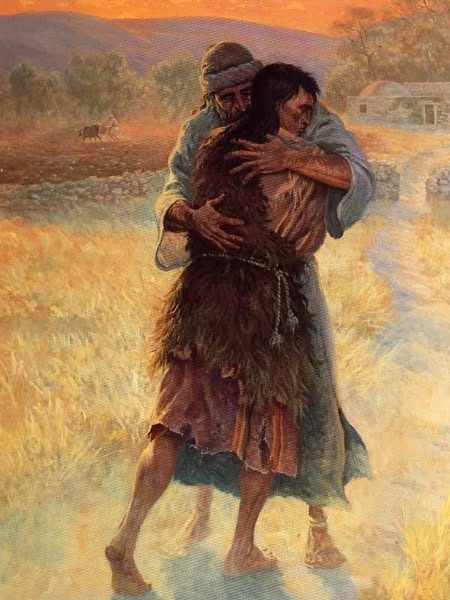
‘While he was still a long way off, his father saw him and was moved with pity. He ran to the boy, clasped him in his arms and kissed him tenderly. Then his son said, “Father, I have sinned against heaven and against you. I no longer deserve to be called your son.” But the father said to his servants, “Quick! Bring out the best robe and put it on him; put a ring on his finger and sandals on his feet. Bring the calf we have been fattening, and kill it; we are going to have a feast, a celebration, because this son of mine was dead and has come back to life; he was lost and is found.” And they began to celebrate.
‘Now the elder son was out in the fields, and on his way back, as he drew near the house, he could hear music and dancing. Calling one of the servants he asked what it was all about. “Your brother has come” replied the servant “and your father has killed the calf we had fattened because he has got him back safe and sound.” He was angry then and refused to go in, and his father came out to plead with him; but he answered his father, “Look, all these years I have slaved for you and never once disobeyed your orders, yet you never offered me so much as a kid for me to celebrate with my friends. But, for this son of yours, when he comes back after swallowing up your property – he and his women – you kill the calf we had been fattening.”
‘The father said, “My son, you are with me always and all I have is yours. But it was only right we should celebrate and rejoice, because your brother here was dead and has come to life; he was lost and is found.”’
Reflection
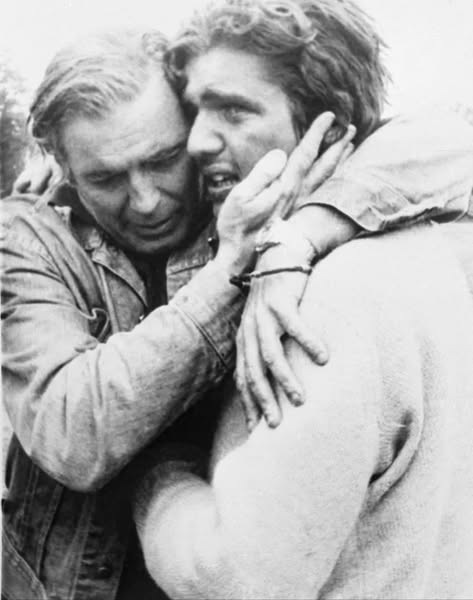
Friends, Carlitos Paez is a seventy-one-year-old man who has lived all his life in Montevideo, Uruguay. To those who know him, he is an exuberant and merry man and not shy. He is an entrepreneur and motivational speaker. His name may not be familiar with many on this side of the world, but in 1972, what happened to him and forty-four other people, echoed around the world, and is very much remembered. Carlitos Paez was one of sixteen people from that group of forty-five who survived a plane crash in the Andes Mountains.
In what became known as ‘The Miracle of the Andes’, for seventy-two days that small band of sufferers faced sub-zero temperatures, exposure, starvation, and a devastating avalanche. The survivors overcame the impossible by doing the unthinkable – they ate the flesh of the dead. In the 2008 book ‘Society of the Snow’, Paez described his experiences on the mountain but also that of his family back home in Uruguay. While many families were reluctantly accepting that their loved ones would never come home, some never gave up hope. Carlito’s’ family was one of those.
He said that his history on the mountain was linked with that of his father, who ‘never once stopped searching’ for him. His father ‘acted with such tenacity, such perseverance, despite all the setbacks he suffered, that he was known in Chile as ‘the crazy old man searching for his lost boy.’ There was no more genuine description of his father than that. His father could not look for him in a rational way, ‘so he had to do so through the inner recesses of madness, of desperation, going down paths never travelled. He consulted maps, clairvoyants, scientists…because what he needed most, besides footprints in the snow and equipment, was hope.’
Paez says that his father defied logic and common sense searching for him until the last day when they were found. Surviving such an ordeal but having sensed the love and searching of his family in his suffering, makes him now all these years later, describe his life as one long journey, ‘a journey from death to life.’
‘A journey from death to life’ is also how the Father in our Gospel describes the return of his reckless son. This father too defies logic and common sense searching for his son, looking out for his return with an unwavering hope. To those looking on, and even to his eldest son, he appears as a crazy old man searching for his lost boy. No one can understand or fathom the depths of his love, mercy, and searching.
The title of the Gospel story may inadvertently keep us focused on the younger son, concentrating our judgment on him, while allowing us to side with the older son, sympathetic to his plight. But in the Parable of the Prodigal Son, what we have is a household where much is offered but little appreciated. Both children are prodigal. Neither son values nor truly knows the devotion their father has for them. Both turn their backs on him in diverse ways. The younger son is obvious in his waywardness, but the older son is rebellious too. He thinks of himself as loyal and co-operative but as in the words of William Butler Yeats: ‘Too long a sacrifice, can make a stone of the heart.’ His heart is closed, angry and self-centred. Still, the father moves to love and embrace him too.
Friends, the Parable of the Prodigal Son is a story for our times. Little of God is appreciated in our world today. While offering so much, not enough of God is respected or reflected back. From individuals, to countries, to Governments, the depths of compassion, understanding, motivation, and devotion to matters profoundly important are often shallow. Focus on trade wars, tariffs, speaking time; denouncing one tyrant while supporting others; lack of funding for services to the most vulnerable, minimising the true value of life, and trying to make all things relative, has led to a selfish, unhappy, and fearful world in many ways.
Yet, we aspire to so much more, we reach for God and we want things to be better. Many work and strive for such a world; making better the families, communities, and countries they belong to. We do not lose hope, and God never loses hope in us either. God goes to outlandish lengths to remind how much we are loved and cherished, and how in His Church, we always have a home and a welcome.
Here, He embraces us with His Forgiveness, clothes us with His Word, and feeds us with His Body. All He needs from us is humility and recognition that we are often lost and in constant need of being found. If we can only appreciate the intensity of God’s love, searching, and welcome for us, and reflect it in some way in our lives, then our life’s journey will also be one of hope; it will be a journey from death to life; from being lost to being found.
Fr. Richard