
Gospel & Reflection for the Twenty-Third Sunday in Ordinary Time.
Luke 14:25‐33
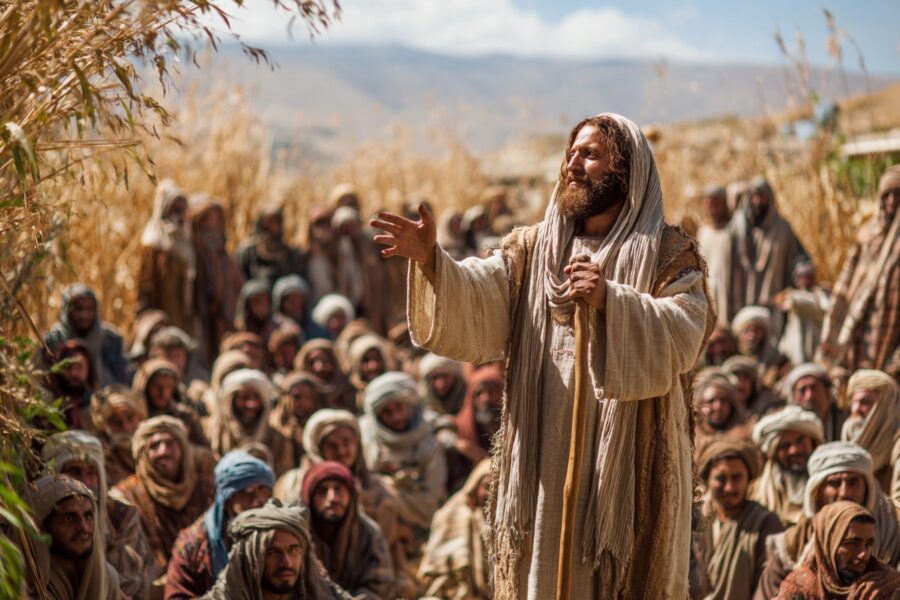
Great crowds accompanied Jesus on his way and he turned and spoke to them. ‘If any man comes to me without hating his father, mother, wife, children, brothers, sisters, yes and his own life too, he cannot be my disciple. Anyone who does not carry his cross and come after me cannot be my disciple.
‘And indeed, which of you here, intending to build a tower, would not first sit down and work out the cost to see if he had enough to complete it? Otherwise, if he laid the foundation and then found himself unable to finish the work, the onlookers would all start making fun of him and saying, “Here is a man who started to build and was unable to finish.” Or again, what king marching to war against another king would not first sit down and consider whether with ten thousand men he could stand up to the other who advanced against him with twenty thousand? If not, then while the other king was still a long way off, he would send envoys to sue for peace. So in the same way, none of you can be my disciple unless he gives up all his possessions.’
Reflection
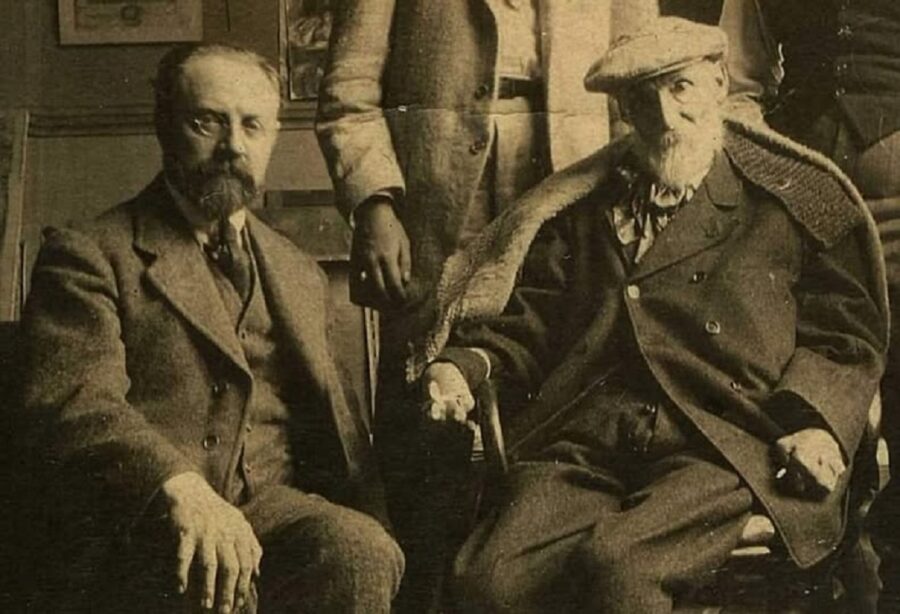
Friends, two painters considered innovators in modern art, were the Frenchmen Pierre-Auguste Renoir and Henri Matisse. Renoir totally changed convention regarding the use of colour. His unique approach influenced Matisse who then developed his own radical approach to colour as a tool of expression. However, despite the fact that Renoir was nearly thirty years older than Matisse, the two men were close friends, sharing a unique connection. Their friendship developed late in Renoir’s life, years which were particularly difficult for him.
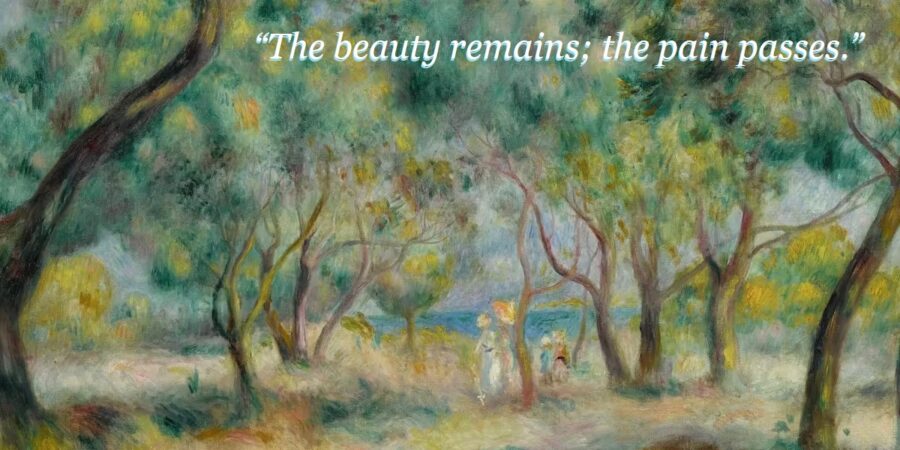
Renoir was virtually crippled by arthritis. Nevertheless, he painted every day; and when his fingers were no longer supple enough to hold the brush correctly, his wife Alice would attach the paintbrush to his hand in order that he might continue his work. Matisse visited Renoir daily and on one occasion, as he watched his older friend wincing in excruciating pain with each colourful stroke, he asked, “Auguste, why do you continue to paint when you are in such agony?” Renoir’s response was immediate, “The beauty remains; the pain passes.”
So, passion for his art empowered Renoir to paint despite the pain. While many admire the beauty of his smiling portraits or his landscapes, or his still life of flowers and fruit, they will find no trace within them of the pain required to create them. Yet, knowing what it took to paint them, most will agree that the cost was worth the result.
Cost and result are what our readings today are about. They remind us that nothing great is ever done without sacrifice, but any sacrifice for Christ is always great. In our first reading from the Book of Wisdom, it is acknowledged that we are finite beings trying to understand the infinite. Yet in the matter of understanding the intentions of God, knowing what God is asking of us, we have not been left to our own devices. We know what God asks of us through the wisdom of the Holy Spirit within us all, which stirs the conscience and reminds us of our obligations.
In our second, St. Paul, paying the cost of knowing and following God’s intentions, sits in his prison cell in Rome. From there, he writes to a friend called Philemon on behalf of a runaway slave belonging to him called Onesimus. Onesimus has also been baptised by Paul. Paul urges Philemon to do something very difficult. He pleads that Philemon accept Onesimus back, not as a slave to be punished for desertion but as a brother in Christ, to be received and treated as an equal. This meant that Philemon would have to go against what his peers and soceity would have expected of him. Yet, Paul was saying to him that by virtue of his baptismal calling, he was being asked to prefer God’s expectation rather than everyone else’s.
Such expectation is also at the heart of the Gospel. In picking up our Cross and following Him, Jesus is challenging us to make a preference for God; to decide for Christ and His ways and teaching, even if this brings us into conflict with others, especially family or friends. Jesus asks us to consider carefully our willingness to pick up such a cross. In telling us to ‘work out the cost’ in order to complete what we are doing, He is calling for a demanding faithfulness, a unique connection, a close friendship that will produce something beautiful in us and through us, that will be worth any agony which our connection to Him might bring to us.
We are under no illusions, faith brings pain. When we choose to look beyond ourselves and the limits of this world, we are seen as doormats, unenlightened, believers of fairy tales. Having unpopular opinions about popular issues wins no friends. Condoning little, while many condone a lot gets us dismissed quickly. Choosing truth over feelings, emotions, self-identification and delusion, gets us branded phobic and bigoted. To simply say ‘I believe’ risks people not trusting or accepting us. But yet, better to stand for something than fall for everything.
The beauty of our faith, the beauty of Christ and His teaching, the beauty of what His followers have and what we continue to create, has lasted these past two thousand years and counting, despite the pain and the rejection which our preference for God has caused.
However, the pain most certainly passes; the beauty undoubtedly remains. Let us choose that beauty always. The cost is worth the result.
Fr. Richard