

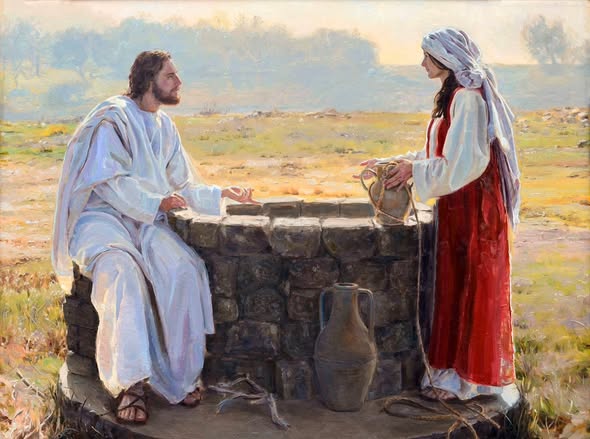
Gospel & Reflection for 2nd Sunday in Lent 2026
John 4:5-42
Jesus came to a town of Samaria called Sychar,
near the plot of land that Jacob had given to his son Joseph.
Jacob’s well was there. Jesus, tired from his journey, sat down there at the well. It was about noon. A woman of Samaria came to draw water. Jesus said to her, “Give me a drink.” The Samaritan woman said to him, “How can you, a Jew, ask me, a Samaritan woman, for a drink?” —For Jews use nothing in common with Samaritans.—
Jesus answered and said to her, “If you knew the gift of God
and who is saying to you, ‘Give me a drink, ‘you would have asked him and he would have given you living water.”
The woman said to him, “Sir, you do not even have a bucket and the cistern is deep; where then can you get this living water?
Are you greater than our father Jacob, who gave us this cistern and drank from it himself with his children and his flocks?”
Jesus answered and said to her,
“Everyone who drinks this water will be thirsty again;
but whoever drinks the water I shall give will never thirst; the water I shall give will become in him a spring of water welling up to eternal life.” The woman said to him, “Sir, give me this water, so that I may not be thirsty or have to keep coming here to draw water.”
Jesus said to her,
“Go call your husband and come back.” The woman answered and said to him, “I do not have a husband.” Jesus answered her,
“You are right in saying, ‘I do not have a husband.’ For you have had five husbands, and the one you have now is not your husband.
What you have said is true.” The woman said to him, “Sir, I can see that you are a prophet. Our ancestors worshiped on this mountain;
but you people say that the place to worship is in Jerusalem.”
Jesus said to her, “Believe me, woman, the hour is coming
when you will worship the Father neither on this mountain nor in Jerusalem. You people worship what you do not understand;
we worship what we understand, because salvation is from the Jews. But the hour is coming, and is now here,
when true worshipers will worship the Father in Spirit and truth;
and indeed the Father seeks such people to worship him. God is Spirit, and those who worship him must worship in Spirit and truth.”
The woman said to him, “I know that the Messiah is coming, the one called the Christ; when he comes, he will tell us everything.”
Jesus said to her, “I am he, the one speaking with you.”
Many of the Samaritans of that town began to believe in him
because of the word of the woman who testified,
“He told me everything I have done.” When the Samaritans came to him, they invited him to stay with them; and he stayed there two days. Many more began to believe in him because of his word,
and they said to the woman, “We no longer believe because of your word; for we have heard for ourselves, and we know that this is truly the savior of the world.”
Reflection
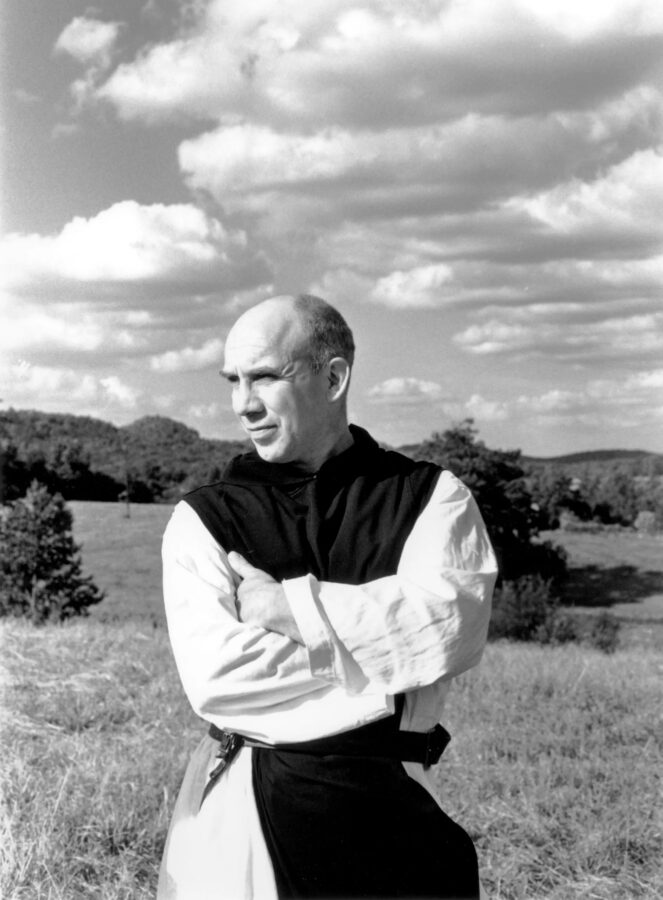
Friends, though dying tragically in an accident in 1968, the American Monk, Thomas Merton, remains one of Catholicism’s most popular theologians, writers, poets, and mystics. Like many who spend long hours tuning their life to God, Merton often had great insights not just with faith, but on life in general. He once reflected, “People may spend their whole lives climbing the ladder of success only to find, once they reach the top, that the ladder is leaning against the wrong wall.”
It was a powerful piece of wisdom provoking a very profound question. Merton was not just asking what are we doing with our lives, he was asking, why are we doing it? We pour so much of ourselves, our time, and our energy into such things as work and careers, reputation and dreams, luxury and comforts, convinced that these will finally, and fully satisfy us. But that is not always the case. Many reach the “top” of their goals and dreams, only to find them unsatisfying and unfulfilling. They are met with unease and confusion. It was not as they had expected it to be and often a new, vastly different search then begins – the search for true meaning and purpose of life.
It is precisely into such confusion about what we have, compared to what we are really seeking, that today’s Gospel speaks to us all about.
In the encounter at the well, we meet the Samaritan woman lugging her heavy water jar in the heat of the noon sun. That jar represents her “ladder”, her life and searching. She has been climbing it for years. She has climbed through one broken relationship after another. She is climbing through social exclusion, seen in how she is drawing water at a time when no one else would be there, the hottest part of the day. So, she is seeking a love that will last and a meaning that will not fail her, but which will include her. She is tired and is thirsty for something she cannot name.
Jesus meets her in her exhaustion and offers a radical correction.
He does not just offer her clean well water; He offers her a new wall to lean her ladder against. Jesus helps her to see what is profoundly important and life giving and what she can do to have it always.
She senses the difference immediately and responds to the Lord’s honesty and challenges: “Sir, give me some of that water so that I may never be thirsty again…”
Friends, Lent is the season where we are all invited to climb down from our ladders, if we think they are leaning against the wrong wall. We are asked to look honestly at everything we think might fill us with all that we need and want, and ask if they will do that for us in a real and meaningful way? This weekend, the Lord takes a place at the well of all our lives. He knows that we are tired with the climb in some way, and asks us to lean our ladder against the only wall that stands firm – our trust and faith in God.
We are being challenged, like the woman at the well to find ‘living water,’ but to find it in a person, Jesus Christ, from whom the living water of mercy, love and true meaning and purpose flow. May we have the courage always to lean on Him.
Fr. Richard