

Gospel & Reflection
Feast of Our Lord Jesus Christ, King of the Universe.
Matthew 25:31‐46
Jesus said to his disciples: ‘When the Son of Man comes in his glory, escorted by all the angels, then he will take his seat on his throne of glory. All the nations will be assembled before him and he will separate men one from another as the shepherd separates sheep from goats. He will place the sheep on his right hand and the goats on his left. ‘Then the King will say to those on his right hand, “Come, you whom my Father has blessed, take for your heritage the kingdom prepared for you since the foundation of the world. For I was hungry and you gave me food; I was thirsty and you gave me drink; I was a stranger and you made me welcome; naked and you clothed me, sick and you visited me, in prison and you came to see me.” Then the virtuous will say to him in reply, “Lord, when did we see you hungry and feed you; or thirsty and give you drink? When did we see you a stranger and make you welcome; naked and clothe you; sick or in prison and go to see you?” And the King will answer, “I tell you solemnly, in so far as you did this to one of the least of these brothers of mine, you did it to me.”
‘Next he will say to those on his left hand, “Go away from me, with your curse upon you, to the eternal fire prepared for the devil and his angels. For I was hungry and you never gave me food; I was thirsty and you never gave me anything to drink; I was a stranger and you never made me welcome, naked and you never clothed me, sick and in prison and you never visited me.” Then it will be their turn to ask, “Lord, when did we see you hungry or thirsty, a stranger or naked, sick or in prison, and did not come to your help?” Then he will answer, “I tell you solemnly, in so far as you neglected to do this to one of the least of these, you neglected to do it to me.”
‘And they will go away to eternal punishment, and the virtuous to eternal life.’
Reflection
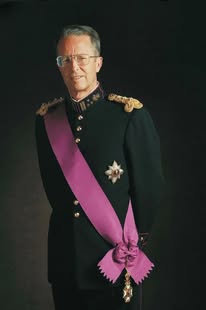
From 1951, until his death in 1993, Baudouin Albert Charles was King of the Belgians. He was a unifying figure, restoring trust in the Monarchy and bridging cultural and political divides. He was also deeply religious, viewing his kingship as a moral duty rather than a purely ceremonial role. A devout Catholic, his personal convictions informed by his faith famously led to a constitutional crisis, when in 1990 he refused to sign a bill legalising abortion. To resolve the political and religious impasse, the Belgian Government declared him temporarily “unable to reign” for 36 hours so ministers could enact the law, before Parliament then restored him to the throne.
He made headlines again the following year, for a very different reason – a quiet, unexpected visitation. He visited a shelter for the homeless and marginalised in Brussels. Those in the shelter had no idea who he was. Without crown or royal entourage, wearing simple clothing and an ordinary coat he sat down on wooden benches, listening to people’s stories and troubles, and later serving them soup and food. One man remarked how kind the stranger was, completely unaware he was speaking to his sovereign! For his lifetime of humility, prayerfulness, commitment to social justice, and his refusal to compromise his conscience, in 2024, the late Pope Francis declared him a ‘Servant of God’, the first step on the road to Sainthood.
We celebrate today the Solemnity of Christ the King, and as we do, the Gospel gives us a striking image of God as a King, but a King who acts in a way contrary to what we might expect of royalty – a way that obviously influenced King Baudouin in how he lived his life of service.
When we hear the title “King of the Universe”, we immediately picture wealth, power, and domination. Yet St. Matthew describes a standard of greatness that is most unexpected. He speaks of a King who walks among and helps people incognito. Christ Jesus, as King, has been and remains constantly present in our lives – listening, serving, and helping us, often unnoticed. “For I was hungry and you gave me food, I was thirsty and you gave me drink, a stranger and you welcomed me, naked and you clothed me, ill and you cared for me, in prison and you visited me.”
The reaction of the people in the Gospel is maybe the same as our own? Both groups ask the exact same question: “Lord, when did we see you?” Neither group recognised him, but such is the mystery of God; such is the mystery of Christ our King. God is hidden, in the ordinary reality and struggles, of daily life.
So, Jesus’ majesty is hidden behind the faces of the vulnerable, the lonely, the overlooked. He is concealed in the person who has no one to talk to, the person who has no one to spend time with them. He is veiled in the family that is broken or quietly struggling. He stands in the shoes of that person who is difficult to love, like, or understand. He can be unseen in the stranger.
But this is the challenge that the feast of Christ the King places before each of us today. It is the challenge of being able to see, wanting to see, Christ in others.
It is about the power we all have to take notice, or to walk right past, the people sitting on the benches of our own daily lives. True discipleship calls upon to shake off pride, busyness, or comfort which keeps us at a distance, and to be with others, especially those feeling invisible or overwhelmed. It is about having the courage of our convictions and the humility to serve without anyone needing to know our name. The Good News, however, is that we are never asked to do this alone, nor do we need grand gestures to build God’s Kingdom. Every small act of patience, kindness, sympathy and love is a moment where the hidden King of the Universe is both served and revealed.
So, on this Sunday, and always, may we have the eyes to recognise Christ in others and the grace to let others glimpse a little of His kindness in us.
Fr. Richard