

Gospel & Reflection For The Third Sunday In Ordinary Time.
Luke 1:1-4,4:14-21
Seeing that many others have undertaken to draw up accounts of the events that have taken place among us, exactly as these were handed down to us by those who from the outset were eyewitnesses and ministers of the word, I in my turn, after carefully going over the whole story from the beginning, have decided to write an ordered account for you, Theophilus, so that your Excellency may learn how well founded the teaching is that you have received.
Jesus, with the power of the Spirit in him, returned to Galilee; and his reputation spread throughout the countryside. He taught in their synagogues and everyone praised him.
He came to Nazara, where he had been brought up, and went into the synagogue on the sabbath day as he usually did. He stood up to read and they handed him the scroll of the prophet Isaiah. Unrolling the scroll he found the place where it is written:
The spirit of the Lord has been given to me,
for he has anointed me.
He has sent me to bring the good news to the poor,
to proclaim liberty to captives
and to the blind new sight,
to set the downtrodden free,
to proclaim the Lord’s year of favour.
He then rolled up the scroll, gave it back to the assistant and sat down. And all eyes in the synagogue were fixed on him. Then he began to speak to them, ‘This text is being fulfilled today even as you listen.’
Reflection
Friends, the history of our world contains too many horrific examples of shattered countries, lives, and peace. History has recorded much too frequently instances of where power struggles have left only rubble, and scattered within it, all which was once special, personal, and protective for people. There are famous pictures of many countries after World War II, where people walk, sit, and run among smoke and ruins. Recent history recorded as it happened, the dust and ash covered thousands who ran from the crashing Twin Towers in New York.
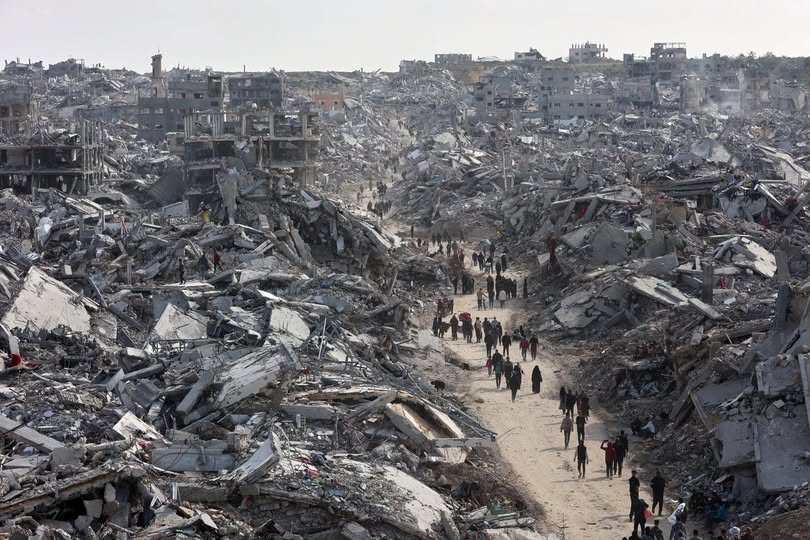
Still, we seem to learn nothing from it all. Over the last few days, our latest image of shattered lives and worlds, are of the people of Gaza returning home. After fifteen months of war, they cheered in celebration of a truce, even with its uneasy peace. But their happiness was short lived. It was overshadowed by the harsh reality of what they found when they did return home. Homes, buildings, cities, towns, all bombed to bits. Everything levelled, everything gone, and in their place, newly formed mountains of rubble.
It has to be asked why Israel felt the need for such a scale of vengeance and annihilation, as it must be asked why the most powerful countries in the world sat back and allowed it to happen? It is all the more disturbing when we think not just of their recent history but of their ancient history, and how they experienced brutally the sacred, the precious, and the personal being left in ruins. The Babylonians, the Persians, the Romans, they all had their violent stab at them. The time after the Persian conquest is covered in our first reading.
The Prophet Nehemiah has returned to Jerusalem many years after it was demolished, and the Israelites exiled into slavery by the Babylonian Empire. One among many, Nehemiah was taken from his homeland, traditions, and faith. In short, his identity as God’s chosen was shattered. But the Babylonians were then conquered by the Persians, and the Persians allowed the Jewish people to return home. Returning home, they find their sacred city and temple a ruin and they sense this decay in their hearts. They are beaten, downcast and lost.
But Nehemiah records the words of Ezra, a Priest and Prophet, who to lift the people’s spirit, tells them that their greatest and boldest identity is not in their fallen walls of rubble but in them as God’s people – “the joy of the Lord is your stronghold.”
This theme of identity is echoed in the Gospel. Jesus openly identifies, who He is and what it is He has to do. He identifies as God, and how He will “bring good news to the poor, proclaim liberty to captives, to the blind new sight, to set the downtrodden free, to proclaim the Lord’s year of favour.” Very boldly, Jesus proclaims Himself as the one of whom the prophets foretold – He is the Messiah, the Saviour.
Identity comes to us in many forms, and we identify with many things. Identity needs boldness and commitment. Friends, for us, Christian identity should be as daring as anything else. But our Christian identity is more than just saying “I am Christian, I am Catholic” – Christian identity is brightly seen and best witnessed in discipleship. Nehemiah and Ezra were disciples and they boldly, confidently spoke as God called them too. The Lord too did the same. He did not just announce good news, He made it a reality through His actions. He talked the talk and walked the walk.
Our identity as Catholic calls on us all to a similar daring and courage in our lives. Our identity as Catholic reminds us that we too are God’s people and that we have been anointed with the Holy Spirit. The Spirit calls us, encourages us, to partake in the Lord’s beautiful mission of compassion, truth, and love for everyone, but especially the poor, the suffering, and the oppressed. This is our calling not just in word, but in action.
We pray today for the courage to bring our beautiful Christian identity alive through all that we say and more importantly, do. It is up to us to fulfil what we listen to through the Scriptures and what we know about Christ.
Fr. Richard