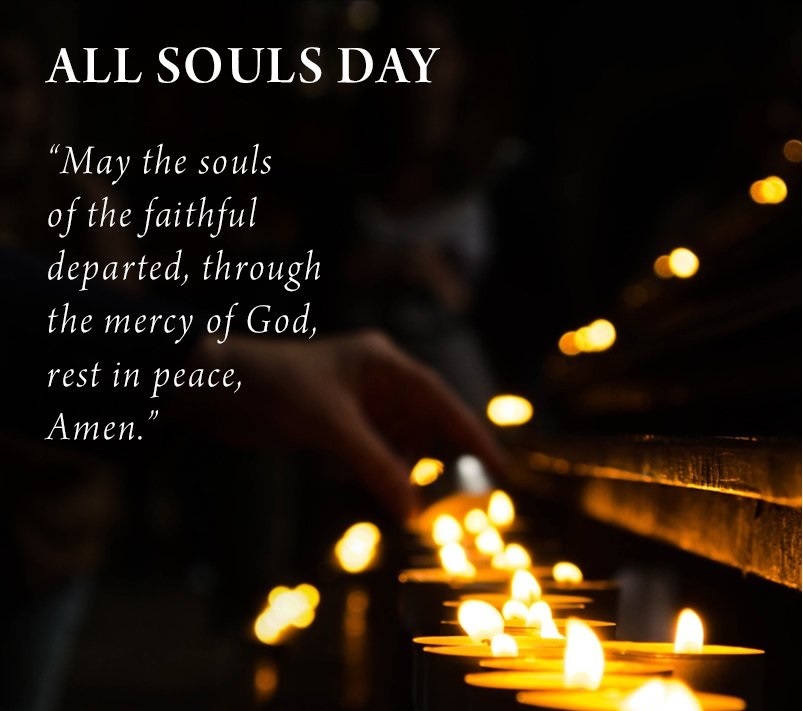


Gospel & Reflection for the Commemoration of All the Faithful Departed – All Souls
Luke 7:11-17
Jesus went to a town called Nain, accompanied by his disciples and a great number of people. When he was near the gate of the town it happened that a dead man was being carried out for burial, the only son of his mother, and she was a widow. And a considerable number of the townspeople were with her. When the Lord saw her he felt sorry for her. ‘Do not cry’ he said. Then he went up and put his hand on the bier and the bearers stood still, and he said, ‘Young man, I tell you to get up.’ And the dead man sat up and began to talk, and Jesus gave him to his mother. Everyone was filled with awe and praised God saying, ‘A great prophet has appeared among us; God has visited his people.’ And this opinion of him spread throughout Judaea and all over the countryside.
Reflection
Friends, in my words about the Gospel last weekend, I mentioned a story about Basil Hume, the late Cardinal-Archbishop of Westminster. Being told that he had terminal cancer, with only a few months to live, Basil Hume reflected that it was best for him to come before God and simply say ‘God be merciful to me a sinner’, because he said, “if I come empty handed, then I will be ready to receive God’s gift”.
However, as you know, Cardinal Hume was a Benedictine Monk. He had lived the life of a Monk for thirty-five years, serving as Abbot of Ampleforth Abbey before his appointment to Westminster. When given his sad diagnosis in 1999, being faithful to his vow of obedience, Cardinal Hume visited Ampleforth and informed the then Abbot of his situation. When Cardinal Hume told him that he was dying, the Abbot, Timothy Wright, was delighted for him! He said ‘Congratulations. I wish I were coming with you.’
Now, that is a true story. Interestingly, very few Catholics know it, even fewer might appreciate it. But one vocal, determined, and famous atheist did. Richard Dawkins, best known for his book ‘The God Delusion’ used that story to promote his own atheistic agenda and as a means of attacking the genuineness and faith of believers. Dawkins says of the story: “The Abbot it seems, really was a sincere believer. But it is precisely because it is so rare and unexpected that his story catches our attention, almost provokes our amusement.”
Obviously, the point that Dawkins is making is that if people who claim to have faith and trust in God, really believed in the promise of Eternal Life with God, would we not be eagerly anticipating our death, like Abbot Timothy Wright? Such a response from believers should be automatic, expected, common, in lines with our beliefs. As it is, such excitement and anticipation are in short supply?
The issue of course is not a lack of belief or trust in eternal life, but an appreciation of the life we have now. We live with a unique tension – the tension between the now, and the forever.
We all cherish the life we have now. We appreciate so many things about it – love, connection, experiences. Our faith tells us that this life, and all it contains is good and gifted to us by our loving and generous God. What better sign of appreciation can we show God than wanting more time, more experiences, more now. The grief we express when earthly life is ending or when it is over, is really a deep compliment arising from our inner most being, for all that God has gifted to us especially through the love of family, friends, and community.
Yet, on the other hand, our faith also commands us to live our lives with our minds and hearts set on the life to come. There, in the forever, we shall experience love, connection, and peace beyond all our imagining; and who does not want or hope for that? So, this is the tension. How do we fully embrace the God given beauty of the present, while at the same time anticipating His beautiful promise of a heavenly future, without fear?
Well, in our Gospel this weekend, Jesus restores the widow of Nain’s son to life. By doing so, Jesus highlights the immense value of human life and the meaningfulness of human relationships. He is deeply moved by the mother’s grief and loss, and intervenes, affirming the importance of one’s life and its meaning in the lives of others. But raising the man from death also provides a powerful reassurance regarding Jesus’ authority over death. Death does not have the last word. In the end, it is only Christ who can bring life from death; and for all who believe in Him, this is our hope, this is our promise, this should be our joy.
Friends, as today we celebrate the Commemoration of all the Faithful Departed, remembering all of our deceased loved ones and friends, we firstly give thanks for their lives and what their life, love, and connection meant to us. At the same time, we trust that they still live, just differently; that they are alive within the mystery that is God and His love.
As we think of them in the forever, we are thankful for our own lives now, while always renewing our hope and anticipation of the life to come. We pray for the grace to receive without fear the gift that God has prepared for us, and all who have gone before us – the gift of life everlasting.
Fr. Richard