


Gospel & Reflection for the fourth Sunday in Ordinary Time
Gospel & Reflection for St. Brigid Feast Day
Matthew 5:1-12a
How happy are the poor in spirit
Seeing the crowds, Jesus went up the hill. There he sat down and was joined by his disciples. Then he began to speak. This is what he taught them:
‘How happy are the poor in spirit;
theirs is the kingdom of heaven.
Happy the gentle:
they shall have the earth for their heritage.
Happy those who mourn:
they shall be comforted.
Happy those who hunger and thirst for what is right:
they shall be satisfied.
Happy the merciful:
they shall have mercy shown them.
Happy the pure in heart:
they shall see God.
Happy the peacemakers:
they shall be called sons of God.
Happy those who are persecuted in the cause of right:
theirs is the kingdom of heaven.
‘Happy are you when people abuse you and persecute you and speak all kinds of calumny against you on my account. Rejoice and be glad, for your reward will be great in heaven.’
Reflection
Friends, there is a fable told of a wise old cat, who noticed a kitten chasing its tail. He asked the kitten: “Why are you chasing your tail so?” The kitten replied: “I have learned that the best thing for a cat is happiness, and that happiness is in my tail. Therefore, I am chasing it: and when I catch it, I shall have happiness.” The old cat replied: “I, too, have judged that happiness is in my tail. But I have noticed that whenever I chase after it, it keeps running away from me, but when I do not chase it and just go about my business, it comes after me wherever I go.”
The pursuit of happiness is common to every person and every culture. For centuries philosophers, theologians, psychologists have searched for and tried to pin down exactly what ‘happiness’ is? People have looked for a definition, an experience, a concrete example of what it looks like and more importantly, how they can attain it? Yet, just as for the philosopher, so for us all, happiness remains a very elusive and fragile thing. It is hard to find and if we do find it, even harder to hold on to. Something as simple as an unconsidered word could ruin whatever sense of happiness we might have. Yet happiness has to be more than positive mood and much more than some constant level of elation.
In our Gospel Jesus speaks about happiness. What He is talking about though, may not be many people’s perfect idea of happiness. ‘Happy are you who are poor…hungry…weep…resented.’ However, there is a lot lost in translation. When the Gospel mentions ‘Happy,’ this is simply the most common translation from the Greek language, and it is a bad translation. ‘Happy’ comes to us from the old English word ‘hap’ meaning chance, fortune, or luck. It refers to what is unpredictable or changeable, and with that kind of understanding of happiness, no wonder like the kitten, we chase it because with some luck, we might just catch it!
Yet the original Greek word describing what Jesus was really saying is ‘Makarios.’ We often translate it as ‘Blessed,’ but its real meaning is a serene and untouchable joy. So, with the Beatitudes, Jesus is referring to a contentment of faith and life that is at the core of our being, and which cannot be disturbed or broken despite the difficulties that we might be going through. Its strength rests in us knowing that God is with us despite all that happens. This serene contentment is true blessedness; it is real happiness. Happiness therefore comes from within; it comes from a life lived with God as one’s source and true centre.
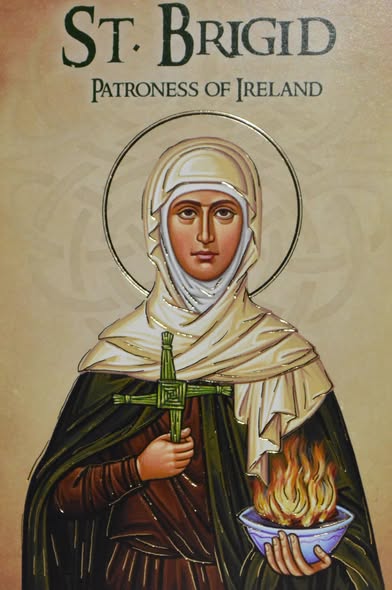
We see ‘Makarios’ beautifully in the life of St. Brigid. She was a woman truly blessed, and in her contented and God centered life, she brought faith and love to many. She shared with the poor, legend saying that she gave away her father’s precious sword to a leper, so he could sell it for food. She was known as a bridge-builder who brought harmony where there was conflict. She even founded a monastery where both men and women lived and prayed together, a radical sign of unity for the time. Brigid was a woman of strength and courage who championed the cause of the wounded and the weary, mercifully caring and nursing them. She was a person pure in heart and she shared her heart, which was full of love and contentment in God, with others.
Friends, in our world today, there is many contenders that claim to offer us true happiness in many ways and through many things. However, when Christ offers happiness, He is not offering us some pleasant feeling of well-being, He is not giving us a good mood, He is not promising that all our dreams will come through. Instead, Christ offers us a special privilege; a desirable inner disposition, where even when life is tough, we have a hope, a promise, a presence in our lives that gives us a security that is the envy of those who do not experience it.
If we can sense our loving God at the core of our being and trust in Him, then even when life is demanding, we can maintain a deep-seated, a deeply rooted happiness. So, just like the beautiful Brigid, may we all know, experience, and share that same serenity, which only God can give and which we all can experience.
Fr. Richard