

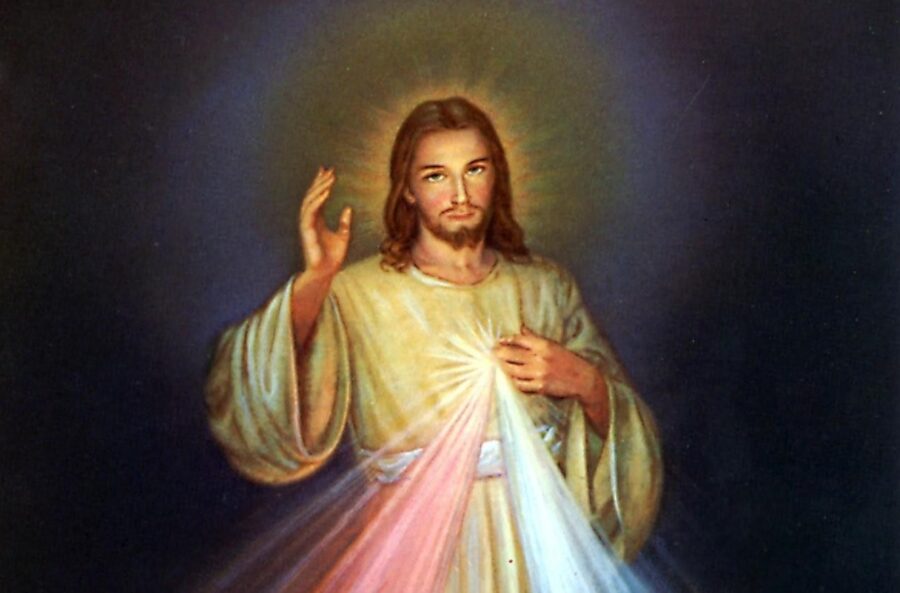
Gospel & Reflection for Divine Mercy Sunday
Gospel & Reflection for Divine Mercy Celebration.
John 20:19-31
In the evening of that same day, the first day of the week, the doors were closed in the room where the disciples were, for fear of the Jews. Jesus came and stood among them. He said to them, ‘Peace be with you’, and showed them his hands and his side. The disciples were filled with joy when they saw the Lord, and he said to them again, ‘Peace be with you.
‘As the Father sent me,
so am I sending you.’
After saying this he breathed on them and said:
‘Receive the Holy Spirit.
For those whose sins you forgive,
they are forgiven;
for those whose sins you retain,
they are retained.’
Thomas, called the Twin, who was one of the Twelve, was not with them when Jesus came. When the disciples said, ‘We have seen the Lord’, he answered, ‘Unless I see the holes that the nails made in his hands and can put my finger into the holes they made, and unless I can put my hand into his side, I refuse to believe.’ Eight days later the disciples were in the house again and Thomas was with them. The doors were closed, but Jesus came in and stood among them. ‘Peace be with you’ he said. Then he spoke to Thomas, ‘Put your finger here; look, here are my hands. Give me your hand; put it into my side. Doubt no longer but believe.’ Thomas replied, ‘My Lord and my God!’ Jesus said to him:
‘You believe because you can see me.
Happy are those who have not seen and yet believe.’
There were many other signs that Jesus worked and the disciples saw, but they are not recorded in this book. These are recorded so that you may believe that Jesus is the Christ, the Son of God, and that believing this you may have life through his name.
Reflection
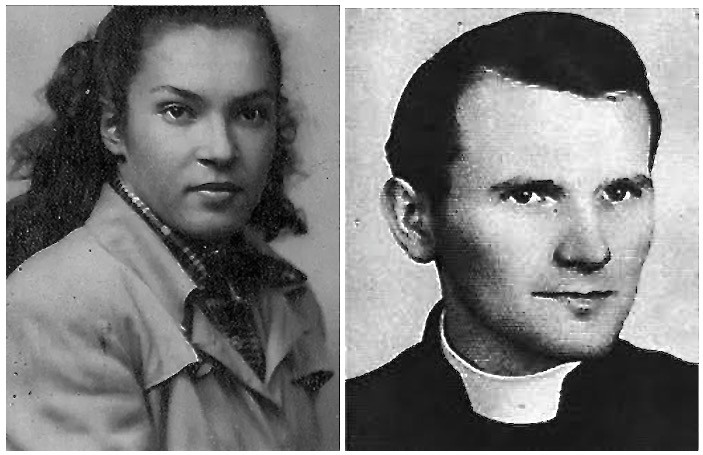
In January of 1945, five months before the end of the Second World War, the Russian Army liberated a concentration Camp in Poland. From that camp ran a young girl called Edith Zierer, who only thirteen years old was hoping to get to her hometown of Krakow to find her parents, who, she would later learn, had died at Auschwitz. Exhausted, she reached a train station and sat there for two days, cold, alone and without food or water, unable to move. People ignored her, no one even looking in her direction. However, as she later described it, “Suddenly, there he was.”
Zierer was referring to a young man, whom she took to be a Priest, but who was in fact still a seminarian. She continued: “He brought me some tea and two pieces of bread with cheese and then he carried me to a train carriage. He sat with me and put his coat on me because it was freezing. We came to Krakow and then I ran away because people started to ask why a Priest was walking with a Jewish girl.” Though running away, she later made a good life for herself, and she kept forever in her memory the name of that handsome and energetic young man who carried her for three kilometres to a train station from where a train to Krakow was leaving; the only person to stop and help her.
The name of this man? Karol Wojtyla – the future Pope and now, Saint John Paul II.
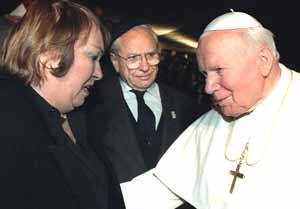
She wrote to him after he became Pope in 1979, saying she was the young girl he had saved at the train station in Poland decades before. A correspondence ensued and in 1998, the Pope invited her to the Vatican, where they were reunited. When John Paul died in 2005, Zierer mourned the death of her former saviour.
She told many reporters that she remembered the warm look in his eyes in that railway station all those years before and God’s mercy expressed in his actions. “He was a kindred spirit in the greatest sense — a man who could save a girl in such a state and carry her to safety. I would not have survived had it not been for him.”
John Paul II had a great love for St. Faustina Kowalska and the spiritual wealth of Divine Mercy, which she promoted. But as that true story about him testifies, for John Paul, Divine Mercy was not just a nice or lofty idea. It was the love of God at work within him. It was a grace that he lived and witnessed to, in all that he said and did.
Who can forget that image of him visiting his would-be assassin, Mehmet Ali Agca, in prison. They sat facing one another, up-close and personal. They spoke quietly, the Pope holding his hand, the hand that had held the gun whose bullet had very nearly killed him. John Paul embraced his enemy and pardoned him. That entire scene was a living icon of mercy; a mercy rising from his believing and faithful heart.
In declaring the Second Sunday of Easter as ‘Divine Mercy Sunday,’ Pope Saint John Paul II said: “The cross, even after the Resurrection of the Son of God, speaks, and never ceases to speak of God the Father, who is absolutely faithful to His eternal love for people. … believing in this love means believing in mercy.”
However, believing in God’s love, trusting in, and promoting His Mercy, we too promote and trust, not an idea but a beautiful reality. God’s love is infinite and it is available to everyone, me, and you, regardless of our sins. As such, we too are called to be living icons of mercy.
As the ‘Secretary of Mercy,’ St. Faustina recorded her visions of Jesus in her diary outlining a message where to be an icon of mercy, we have to follow the ABC:
Ask for His Mercy, Be Merciful, and Completely Trust in Jesus.
We see the world as it is, but we ache for what it must become. We ache for it to be more merciful but that through our merciful heart, that the world and its people will see and trust in God, who loves us all beyond comprehension. We know only too well that we live in a troubled, violent, discontented world. One look at the news, one turn of a newspaper page, one news alert on our phone and for the most part it is bad news. Wars, violence, displacement, greed. It can be overwhelming at times. Yet, beauty, humanity, and faith pervade everywhere. In the worst of situations, love and God are to be found. When found, and wherever seen, this is Divine Mercy at work, Divine Mercy coming alive through so many people.
St. Thomas experienced this mercy. Christ did not condemn Thomas for his hesitancy and skepticism. Instead, he returned specifically for him, so that he could finally accept and believe. Jesus went out of His way to meet Thomas in his spiritual isolation. He invited him to touch and to be transformed – to be no longer a ‘doubting Thomas’ but a ‘believing Thomas.’ What beautiful mercy that was!
Friends, we pray today, that through our active and lived faith, that we will continue to strive together to transform our own families, community, and society by bringing to life in a tangible way the love and mercy of God we have experienced.
We not only speak or pray words of mercy, but we also ask for the grace to give mercy our hands, our heart, our time, our energy so that we too can carry others to the security of Jesus’ merciful heart. We seek to embody mercy, as best as we can, as often as we can, so that our lives will join the likes of St. Faustina, John Paul II, and many more, who continually inspire people to know the mercy of God in their lives and to put it into practice.
“Jesus, I trust in You.”