

Gospel & Reflection for Good Friday.
Gospel of St. John
So they took Jesus, and, carrying the cross himself, he went out to what is called the Place of the Skull, in Hebrew, Golgotha.
There they crucified him, and with him two others, one on either side, with Jesus in the middle. Pilate also had an inscription written and put on the cross. It read, “Jesus the Nazorean, the King of the Jews.” Now many of the Jews read this inscription, because the place where Jesus was crucified was near the city; and it was written in Hebrew, Latin, and Greek. So the chief priests of the Jews said to Pilate, “Do not write ‘The King of the Jews,’ but that he said, ‘I am the King of the Jews’.” Pilate answered, “What I have written, I have written.”
When the soldiers had crucified Jesus, they took his clothes and divided them into four shares, a share for each soldier. They also took his tunic, but the tunic was seamless, woven in one piece from the top down. So they said to one another, “Let’s not tear it, but cast lots for it to see whose it will be, “ in order that the passage of Scripture might be fulfilled that says: They divided my garments among them, and for my vesture they cast lots. This is what the soldiers did. Standing by the cross of Jesus were his mother
and his mother’s sister, Mary the wife of Clopas, and Mary of Magdala. When Jesus saw his mother and the disciple there whom he loved he said to his mother, “Woman, behold, your son.” Then he said to the disciple, “Behold, your mother.” And from that hour the disciple took her into his home.
After this, aware that everything was now finished, in order that the Scripture might be fulfilled, Jesus said, “I thirst.” There was a vessel filled with common wine. So they put a sponge soaked in wine on a sprig of hyssop and put it up to his mouth. When Jesus had taken the wine, he said, “It is finished.” And bowing his head, he handed over the spirit.
After this, Joseph of Arimathea, secretly a disciple of Jesus for fear of the Jews, asked Pilate if he could remove the body of Jesus.
And Pilate permitted it. So he came and took his body.
Nicodemus, the one who had first come to him at night, also came bringing a mixture of myrrh and aloes weighing about one hundred pounds. They took the body of Jesus and bound it with burial cloths along with the spices, according to the Jewish burial custom.
Now in the place where he had been crucified there was a garden,
and in the garden a new tomb, in which no one had yet been buried. So they laid Jesus there because of the Jewish preparation day; for the tomb was close by.
Reflection
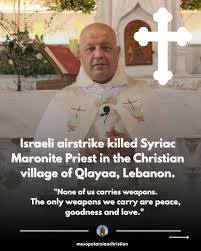
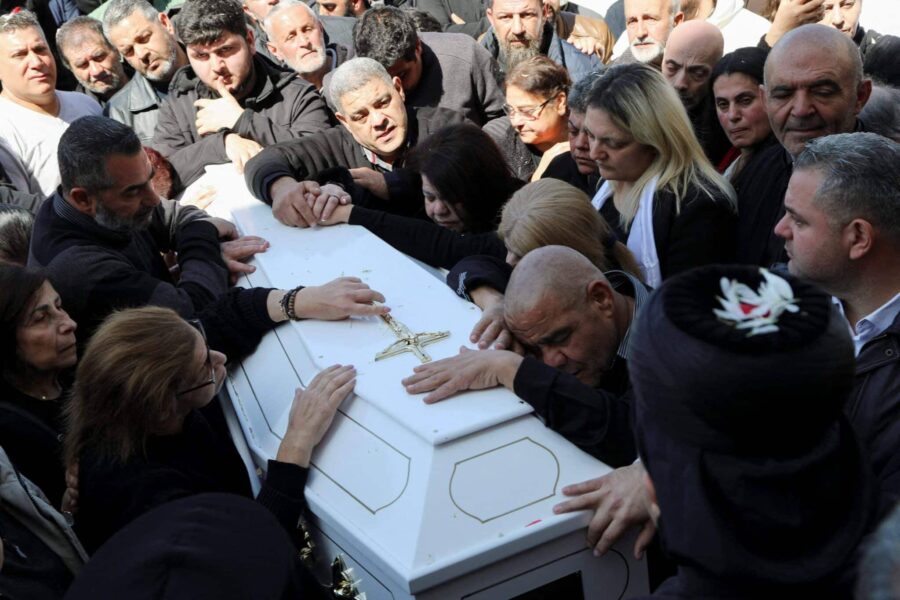
Friends, on the 11th of March just gone, as Israeli drones buzzed overhead, the bells of a small, southern Lebanon village Church pealed their sad, lonely sound in unison with the cries of parishioners, as the coffin of their Priest, Fr. Pierre Al-Rahi, arrived at the Church he ministered in.
Just days before in that same Church, Fr. Al-Rahi had announced that he would be staying with those parishioners of his who were not going to be forced to leave their homes and livelihoods because of the increasingly violent conflict, instability, and tension erupting around them. Though ordered to evacuate by the Israeli Army, Fr. Al-Rahi refused, choosing to stay with his people in their suffering. One of those parishioners said: “He gave us strength to stay rooted here.”
But when an Israeli tank shell struck a house in the village, Fr. Al-Rahi and others rushed to help the wounded elderly couple living there. As they were doing so, a second shell struck, wounding Fr. Al-Rahi and the five young people helping him. Though rushed to a local hospital, he died from his wounds later that day.
As Fr. Al-Rahi was being laid to rest on that March morning, in Rome Pope Leo remembered him and his sacrifice. Pope Leo noted that in Arabic, ‘El-Rahi’ means “shepherd”. “Father Pierre,” he said, “was a true shepherd who always remained beside his people with the love and sacrifice of Jesus the Good Shepherd.”
But what inspired Fr. El-Rahi to be that shepherd and to do what he did? Who gave him the courage to stay rooted in his ministry and stand with his people? The answer is God and the willingness to pick up the Cross and follow Him.
But friends, such is the power and the influence of the Cross. Only the emptiest and cruel of hearts can look past it, and not be moved, inspired, or drawn to it.
Fr. Al-Rahi accepted the Cross. In his courageous decisions and actions, which were inspired and driven by the Cross of Christ, today too, we acknowledge the Cross’ presence and meaning in our lives. We reflect on what it stands for, what it inspires us to be, what it calls us to do. Like Fr. Al-Rahi, we are drawn to and driven by the cross; and like Him, we pray for the courage never to turn from it, deny it, or try to avoid it.
The Cross shines out to us at every stage of our lives It reminds us to give unto God our all, knowing that only God can give us what we need to be faithful and courageous in our own difficulties. That only God can give us the strength to carry the Cross with Him.
Father, into your hands we commit our spirit.
Fr. Richard
Reflection
Good evening, everyone and welcome as we gather for the beginning of our Easter Triduum – our three days of accompanying Christ through His passion, death, and Resurrection. These days are not separate occasions. They combine to make one celebration, each day leading us into the other. Our Mass tonight celebrates the Last Supper, where Christ instituted the Eucharist, but this leads us into Good Friday, and Good Friday brings us to Easter, to the Resurrection.
So, one celebration, spread out over three days and these days are the most important, most beautiful, most solemn of our Church’s year. Thank you for taking this journey and celebrating with us.
There is a true story told of our late Pope, Saint John Paul II. Shortly after his election as Pope in 1979, a foreign official came to the Vatican asking to speak immediately with the new Pope about a pressing matter. The Pope’s Secretary went to his room to inform him, but he was not there. He then checked his office, his library, his private Chapel, even the kitchen and the roof! He looked everywhere one might expect to find an important world leader but could not find him.
His Secretary then went to a Priest who knew the Pope well. He said to him, “I have lost the Holy Father. I have looked everywhere and cannot find him.” The Polish Priest then asked immediately and calmly, “Did you look in the Chapel?” “Yes,” he said, “he is nowhere in sight.” “Go further in,” the Polish Priest said, “but do not turn on the light.” The Secretary went back to the Pope’s private Chapel and walked quietly further into that darkened, sacred space. There, in front of the tabernacle, lying prostrate on the floor before the Blessed Sacrament was Pope John Paul.
Laying there before the Lord in the Eucharist, Pope John Paul was not just saying his prayers. He was undoing the distance between himself and God, and in God’s presence through the Blessed Sacrament, he was acknowledging that despite his new title and the grandeur and power of the Vatican, he was first and foremost a servant of God and of His people, just as God was a servant to him and us all.
Well, this also is the profound significance of our celebration tonight.
We remember Christ first as a servant. In the Gospel, we heard how He wrapped a towel around His waist and then washed the feet of His disciples, the most lowly of tasks but done without hesitation. Through that action, Christ shows us that the path to holiness is not found in titles, positions, or power but in a willingness to be grounded in sincere and loving service of others.
Secondly, Jesus gifts us with the Eucharist. He did not leave us a symbol or a souvenir; the Lord left us Himself. Some consider God remote, cold, distant. However, nothing could be further from the truth. God is present to us always and His presence is intentional, intimate, and inspiring. Through the Eucharist, the space which we might think exists between us and God is undone. On the Altar, in communion, God makes Himself physically present to us. We are in His company, and He invites us to consume Him into our very being.
So, tonight, we go further in. Like Pope John Paul II, we close the distance between ourselves and God. We come close to Christ in a most special way, recognising that our lives are not about only about what we achieve but whom we encounter.
Tonight, and always, Jesus invites us to encounter Him. He beckons us to meet Him, to be with Him, to accept Him but also to be inspired and strengthened by Him.
He wants us to know that true strength, love, and hope are found in our lives being prostrate before the Lord in many ways – in receiving Him in the gift of the Eucharist and then in serving Him in how we love, care, and help others. We are called to become He whom we receive in the Eucharist and then to be Christ-like to others in loving service.
May we have the grace to do so, always.
Fr. Richard