

Gospel & Reflection
Gospel & Reflection for the Eighteenth Week in Ordinary Time.
Matthew 14:13-21
When Jesus heard of the death of John the Baptist,
he withdrew in a boat to a deserted place by himself.
The crowds heard of this and followed him on foot from their towns. When he disembarked and saw the vast crowd,
his heart was moved with pity for them, and he cured their sick.
When it was evening, the disciples approached him and said,
“This is a deserted place and it is already late;
dismiss the crowds so that they can go to the villages
and buy food for themselves.” Jesus said to them, “There is no need for them to go away; give them some food yourselves.”
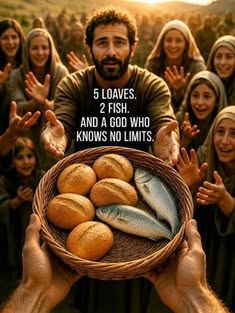
But they said to him, “Five loaves and two fish are all we have here.”
Then he said, “Bring them here to me,” and he ordered the crowds to sit down on the grass. Taking the five loaves and the two fish, and looking up to heaven, he said the blessing, broke the loaves,
and gave them to the disciples, who in turn gave them to the crowds. They all ate and were satisfied, and they picked up the fragments left over— twelve wicker baskets full. Those who ate were about five thousand men, not counting women and children.

Reflection
A little over two months ago, a man by the name of Scott Borba was ordained a Catholic Priest in California. Borba had been a multi-millionaire, the co-founder of e.l.f Cosmetics, a global beauty empire. He had lived in a mansion in the Hollywood hills, drove luxury cars, mixed with celebrities on many red carpets. He appeared to have everything the modern world promises; a man who we could say of, had ‘made it’. Yet, despite his wealth, red carpet appearances, and worldly luxury, Borba felt completely empty inside. The turning point for him came one night, when sitting alone in his mansion he found himself asking a question that cut through all the glamour and success: “What is life about? Is it just trying to acquire, and then we die?”
He said that it was then that he suddenly realised that he was not the man his mother and father created him to be or the man God created him to be. This realisation changed his life. He saw how spiritually starved and bankrupt he was despite his material success. He walked away from his business and fortune, sold his luxury cars, donating his wealth to many charities. He entered seminary, trading tailored suits for a simple cassock and was ordained a Priest in May just gone. When asked by the New York Times about giving up his billion-dollar empire and being ordained, he stated that he had never been as “happy, joyful, or more fulfilled”.
Friends, we live in a culture consumed by the want of more. We are constantly told that if we acquire enough – enough wealth, recognition, fame and even beauty, then our deepest hungers will be satisfied. But much of what promises to satisfy, mostly leaves us starving. It is this truth that brings us to the heart of our Gospel this weekend.
The miracle of the multiplication of the loaves and the fish, is one of only a few miracles of Jesus that are recorded in all four gospels. It was a moment in His life and ministry that was so important, that those writing about Jesus many years later, knew that they had to include for our benefit. It’s important because not only does the miracle point to the divinity of Jesus but it also foretells the Last Supper and therefore, our own Eucharistic celebration today.
Just as He would do at the Last Supper, so with the miracle of the Loaves and with every celebration of Mass, we remember Jesus looking to heaven; giving thanks; breaking the bread and sharing it. So, this miracle is a very significant. It points to Jesus as the Son of God, as the Bread of Life, the One who fulfills faithfully His promise to feed and satisfy completely.
Unfortunately, in recent years it has been saddening to read how many commentators, some Catholic, who have tried to trivialise and diminish this powerful moment in Christ’s life. These commentators would say that there was no miracle at all; that Jesus just got everyone present to share what food they had with others – a giant picnic so to speak. This explanation, while plausible and rational to some, reduces Christ to nothing more than an event manager; someone capable only of getting people to work together.
If it were beyond Jesus’ capability to work miracles, how could we then ever believe or trust in Him as being capable of doing anything more significant and life giving? How could we seriously believe that He cured the sick, raised the dead, and was raised Himself? How could we trust His promises, especially of salvation? Belief in such a limited Jesus would leave us forever a starving people, and the likes of Scott Borba would be still lost, and unchanged.
Thankfully, we don’t accept or explain miracles away in nice terms. We believe in who Christ was, what it was that He was able to do and continues to do for us. We see Him, trust Him, and believe in Him, giving Him our little, for Him to take it and then give us His plenty. We look to and rely always on Jesus Christ as God. We trust in Him who did far more than just encouraged people to share but who fed them as much as they wanted from the little that was there, because He is God. A little is what we will always have but in God’s hands and with God’s help, a little can do so much. Problems can be overcome; fear can be faced; prayers will be answered; miracles do happen.
Friends, may we never make light of Christ in anyway. When we trivialise our Lord, we trivialise and limit the potential of God in our own lives – God who nourishes our lives completely, who never leaves us hungry and who can make us happy, joyful and fulfilled.
Fr. Richard