

Gospel & Reflection for the Fifth Sunday of Lent.
John 11:3-7. 17. 20-27. 33-45
The sisters Martha and Mary sent this message to Jesus, ‘Lord, the man you love is ill.’ On receiving the message, Jesus said, ‘This sickness will not end in death but in God’s glory, and through it the Son of God will be glorified.’ Jesus loved Martha and her sister and Lazarus, yet when he learned that Lazarus was ill he stayed where he was for two more days before saying to the disciples, ‘Let us go to Judaea.’
On arriving, Jesus found that Lazarus had been in the tomb for four days already. When Martha heard that Jesus had come she went to meet him. Mary remained sitting in the house. Martha said to Jesus, ‘If you had been here, my brother would not have died, but I know that even now, whatever you ask of God, he will grant you.’
‘Your brother’ said Jesus to her ‘will rise again.’ Martha said, ‘I know he will rise again at the resurrection on the last day.’
Jesus said: ‘I am the resurrection and the life. If anyone believes in me, even though he dies he will live, and whoever lives and believes in me will never die. Do you believe this?
‘Yes Lord,’ she said ‘I believe that you are the Christ, the Son of God, the one who was to come into this world.’ Jesus said in great distress, with a sigh that came straight from the heart, ‘Where have you put him?’ They said, ‘See how much he loved him!’ But there were some who remarked, ‘He opened the eyes of the blind man, could he not have prevented this man’s death?’
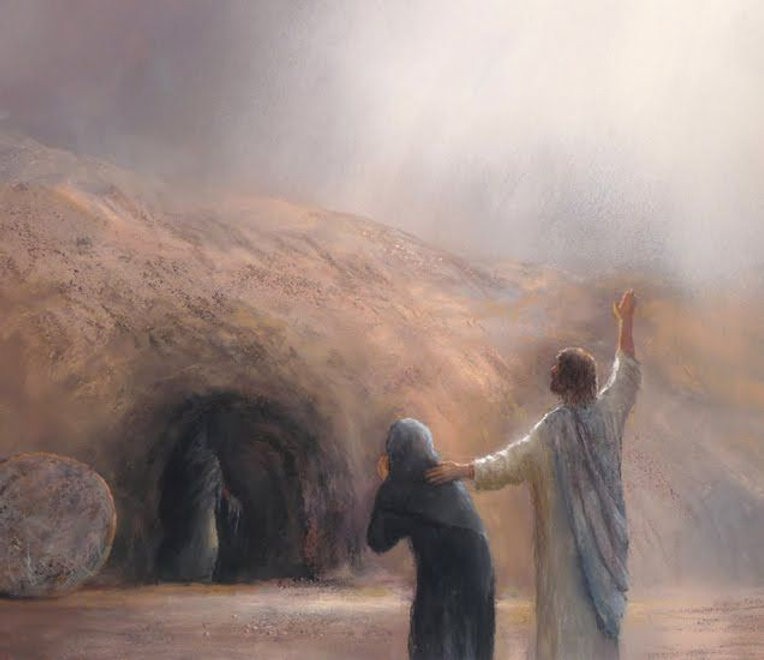
Still sighing, Jesus reached the tomb; it was a cave with a stone to close the opening. Jesus said, ‘Take the stone away.’ Martha said to him, ‘Lord, by now he will smell; this is the fourth day.’
Jesus replied, ‘Have I not told you that if you believe you will see the glory of God?’ So they took away the stone.
Then Jesus lifted up his eyes and said:
‘Father, I thank you for hearing my prayer. I knew indeed that you always hear me, but I speak for the sake of all these who stand round me, so that they may believe it was you who sent me.’
When he had said this, he cried in a loud voice, ‘Lazarus, here! Come out!’
The dead man came out, his feet and hands bound with bands of stuff and a cloth round his face.
Jesus said to them, ‘Unbind him, let him go free.’
Many of the Jews who had come to visit Mary and had seen what he did believed in him.
Reflection
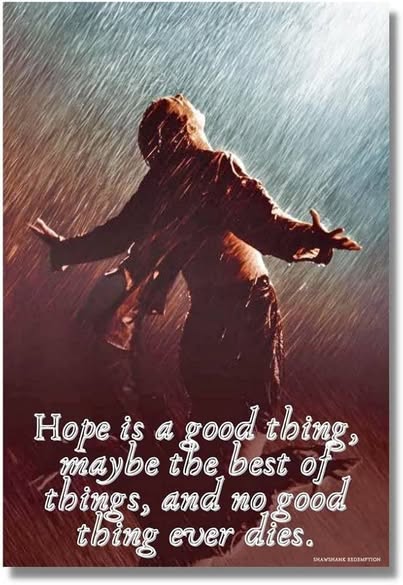
Friends, despite a poor initial box-office performance, the 1994 film ‘The Shawshank Redemption’ has since become something of a cultural phenomenon. It is often cited in the Top Ten list of the greatest films of all time by both the public and critics alike. It’s central themes of hope and friendship strike an immediate emotional cord with audiences and continues to do so with every new generation of movie lovers.
As we know, the film tells the tale of a man called Andy Dufresne, a man who is buried, not in the earth, but behind the grey stone walls of Shawshank Prison. Dufresne is entombed by a life sentence for a crime he did not commit. As he serves his time, he notices how many of his fellow inmates have become institutionalised, their hearts and spirits slowly decaying with each passing year. They have accepted the prison as their tomb, refusing to hope for anything because as his best friend Red believes, “hope is a dangerous thing…it can drive a man insane”.
But Andy Dufresne does not agree with that. He holds on to hope, refusing to let his spirit and heart slowly decompose. He famously says, “Get busy living, or get busy dying.” Andy keeps his heart joyful and his spirit hopeful in different ways. He plays Mozart over the prison speakers; he builds a library; he nurtures and values friendship, and he plots a future beyond the walls.
The climax of the film sees Andy finding freedom. He crawls through a five-hundred-yard sewer pipe, emerging on the other side reborn. Standing in the pouring rain, he has come out of the tomb that was Shawshank and he immediately strips off his prison clothes, his burial cloths, and throws his arms wide in a cruciform pose. He has been resurrected and not through his own power alone, but by hope, that “dangerous thing” to the world, but a saving thing to every soul. He later writes to his friend Red encouraging him to reconsider his understanding of hope, saying, “Remember, hope is a good thing, maybe the best of things, and no good thing ever dies.”
Today is the final Sunday of Lent. Next weekend, we arrive at Palm Sunday and our beautiful journey into Holy Week. Our Gospel parallels all that is to happen to Christ during Holy Week, His journey from life to death, from the tomb to the Resurrection. While it appears as if the resurrection of Lazarus is the highpoint of the Gospel story, it is not. Lazarus was raised from the dead, but he would die again someday, as Martha and Mary would, as will we all. The real peak is the hope which Christ promises and gives us all, when He spoke to Martha saying: ‘I am the resurrection and the life. If anyone believes in me, even though they die, they will live, and whoever lives and believes in me will never die’.
Jesus was saying that our bond with Him, which our faith creates, will not be broken by anything, even death. Our communion with Him, which is the fruit of our faith, endures beyond death. The Lord’s love and friendship with us lasts, not just for our earthly lives but into eternal life. Lazarus would come to experience this everlasting union eventually, as did Martha and Mary, and we to will know it, when our time comes. Jesus came that we may have life and have it to the full. This was the purpose of His life, death, and Resurrection; and the purpose and goal of our lives is to surrender to His love and friendship. With God’s love and friendship, we have the best of things.
So, let us keep our hearts joyful and our spirits hopeful. Let us get busy living – living our faith, our trust, our love of Christ in all that we say and do because with God we have the best of everything, we have our greatest hope.
Fr. Richard