

Gospel & Reflection for the Third Sunday of Lent.
Luke 13:1-9
Some people told Jesus about the Galileans whose blood Pilate had mingled with the blood of their sacrifices.Jesus said to them in reply,“Do you think that because these Galileans suffered in this waythey were greater sinners than all other Galileans? By no means! But I tell you, if you do not repent, you will all perish as they did! Or those eighteen people who were killed when the tower at Siloam fell on them— do you think they were more guilty than everyone else who lived in Jerusalem? By no means! But I tell you, if you do not repent, you will all perish as they did!”
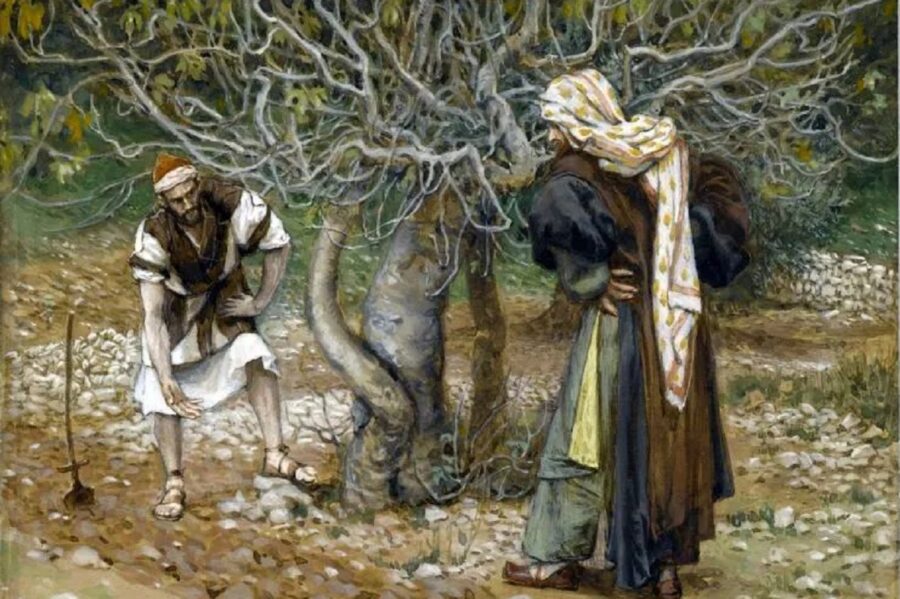
And he told them this parable: “There once was a person who had a fig tree planted in his orchard, and when he came in search of fruit on it but found none, he said to the gardener, ‘For three years now I have come in search of fruit on this fig tree but have found none. So cut it down. Why should it exhaust the soil?’ He said to him in reply, ‘Sir, leave it for this year also, and I shall cultivate the ground around it and fertilize it; it may bear fruit in the future. If not you can cut it down.’”
Reflection
Friends, there is a story recorded of a Jewish Rabbi who during the Second World War was told that many members of his congregation had been rounded up and sent ‘away.’ On hearing this news, the Rabbi threw his hands up to heaven and cried out “If only I was God!” The person who had told him the news asked, “But Rabbi, if you were God, what would you do differently?” To which the Rabbi responded, “If I were God, I would not do anything differently, but at least I would understand.”
One of the most often asked questions in Christianity is: ‘Why does God allow bad things happen?’ That question, countlessly asked, shows how people long to understand the ways of God especially in times of tragedy, sadness, and pain. While we know deep within that God does not will evil to happen, when it does, we seek simply to comprehend a very great mystery. However, trying to understand God, trying to explain God away, is a relatively new trend. During the time of Our Lord, people never asked such questions and never sought to understand the ways of God. People were certain that they knew God very well. They had a simple theology – God rewarded the good and punished the bad! If good things happened, people knew why. If terrible things happened, they were even more certain about why they happened!
There was a common misinterpretation that if personal misfortune or social tragedy occurred, it was the result of sin. A person suffering from illness or bad luck was in widespread belief being punished by God for something that they did wrong. A city or country facing famine, war, or occupation was being chastised for not being faithful enough to God’s law. This was widely held belief and the accepted wisdom before, during and after the life of Christ.
So, when the people come to Jesus in our Gospel, two tragedies are on their minds. One is about a group of Galileans who had come to Jerusalem on pilgrimage and while there, had been massacred in the Temple on the orders of Pilate, for no reason other than Pilate flexing his authority. The other tragedy is about eighteen people who had been killed when a tower at Siloam, another special place of pilgrimage on the outskirts of Jerusalem, had fallen on them during their prayers. However, while we might think the people are coming to Jesus because of grief, shock, or anger over these tragedies, the opposite is true. They are coming for gossip; they wanted to know what these people had done in their lives to upset God so much that God would punish them in such a way?
In response, Jesus does not defend or explain God. Instead, He challenges those before Him. He tells them that the victims of their recent rumouring’s were not being punished for anything, nor were their deaths God’s will. But Jesus asks the people to let these tragic incidents be a jolt out of their own complacency. He demands that those events be a wakeup call to how they themselves lived their lives before God; and if repentance was needed, then they should repent before anything unexpected happened to them.
However, repentance for Jesus, was not sackcloth, ashes, or regret. The word best used to describe what Jesus was talking about is Metanoia – meaning a change of mind; a new way of thinking and seeing. Metanoia, as used by Jesus was a summons to look at life differently and to change what needs changing. This difference is captured in the owner of the vineyard compared to the gardener of the Gospel parable. The owner, in his impatience, sees only a bad tree and wants it cut down. The gardener, not giving up hope, thinks and sees things differently. He wants time to see if things can change. Metanoia captures also what happens to Moses. His life is turned round, redefined, after his encounter with God. He sees things differently, and he responds to the change of path and life that God asks of him. He is transformed by his decision to follow God’s way more than his own.
Friends, Lent is a time of repentance. It is our time for metanoia. It is our moment of seeing the holy ground that we stand on; the ground of our relationships with others, our community, and with God and to see if they need changing or redirection to make them even better. God never gives up on us, calling us always to a deeper relationship with Him, giving us time to respond. This Lent, let us not waste the time He has given us to do just that.
Fr. Richard
