


Gospel & Reflection for the Fifth Sunday of Lent
John 8:1-11
Jesus went to the Mount of Olives. At daybreak he appeared in the Temple again; and as all the people came to him, he sat down and began to teach them.
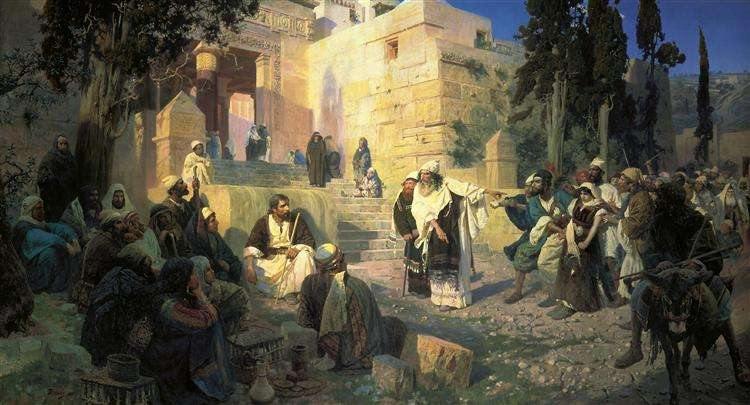
The scribes and Pharisees brought a woman along who had been caught committing adultery; and making her stand there in full view of everybody, they said to Jesus, ‘Master, this woman was caught in the very act of committing adultery, and Moses has ordered us in the Law to condemn women like this to death by stoning. What have you to say?’ They asked him this as a test, looking for something to use against him. But Jesus bent down and started writing on the ground with his finger. As they persisted with their question, he looked up and said, ‘If there is one of you who has not sinned, let him be the first to throw a stone at her.’ Then he bent down and wrote on the ground again.
When they heard this they went away one by one, beginning with the eldest, until Jesus was left alone with the woman, who remained standing there. He looked up and said, ‘Woman, where are they? Has no one condemned you?’ ‘No one, sir’ she replied. ‘Neither do I condemn you,’ said Jesus ‘go away, and do not sin any more.’
Reflection
Friends, Napoleon Bonaparte had a military law stating that any soldier who was absent without leave would be shot if captured. This rule was lethally enforced by the Emperor without exception until a soldier, who happened to be the seventeen-year-old son of Napoleon’s cook, ran away. When he was captured, his mother asked Napoleon for mercy. He said, “Woman, your son doesn’t deserve mercy.” She replied, “Yes, of course, you are right. He does not deserve mercy. If he deserved it, it would no longer be mercy.” Napoleon responded, “Well, then, I will have mercy.” He spared the young soldier’s life.
As we know too, mercy is not mercy if it is deserved, just as a gift is not a gift if earned. In our human relationships we tend to present gifts based on merit, and we can sometimes mistakenly apply the same principle to our relationship with God. Yet, all that comes to us from God is totally undeserved, but it does call for a response. Our Gospel for this Sunday contains the story of the woman caught in adultery. While all around her stand in judgement, calling for the law to be applied with lethal force, only Jesus shows her mercy. But having showed her such great mercy, He then calls for a response from her: “don’t sin anymore.”
It is a curious story; strange in the fact that most scripture scholars agree that it was not originally part of the Gospel as penned by St. John. It is not found in the earliest, and best surviving Greek manuscripts of his writings. In other words, its style, and place is so different from the rest of the Gospel, that it is believed to have been an orphaned piece of tradition about Jesus that was adopted, and found a home in later manuscripts of John’s Gospel. Fr. Raymond Brown, arguably the greatest scripture scholar of modern times states: ‘Its succinct expression of the mercy of Jesus is as delicate as anything in St. Luke; [but] its portrayal of Jesus as the serene judge has all the majesty that we expect of John.’
Either way, from the earliest centuries of the Church, many were rightly anxious to preserve this remarkable encounter in the life of Christ in written form, and they found a place for it in the eight chapter of the Gospel of St. John, the agreed perfect Gospel and Evangelist to claim it.
So, why is it such an important and significant story for people to remember and celebrate?
Well, while we might get distracted with questions such as why was it just the woman condemned and not the man with her; or what was Jesus writing on the ground, the main point of the Gospel is the grace and mercy of God in every circumstance. Jesus’ writing on the ground expresses His refusal and disengagement from any thing or anyone that tries to control where God’s clemency and tenderness should be directed and to whom. Not one of us, male or female, for any reason, is excluded from God’s love, mercy, or hope.
Mercy is the fruit of God’s unconditional love for us all. It is at the very heart of Jesus’ message and ministry, expressing His concern for our well-being, as people created in the image of God, who is Love. In Jesus’ words and actions, it is clear that God wants us to be healed, wants us to be fully alive and well at all levels of our being – spiritually, psychologically, physically, and socially. Jesus’ entire life was an outward expression, a living sacrament of God’s mercy, compassion, and forgiveness.
So, Jesus deals with sin not by condemnation and punishment. Neither does He condone sin. Instead, He sees it as a plight from which people must be set free. Therefore, we are asked to remember today that if someone such as the tyrannical Napoleon could be convinced of the need for mercy in a situation in which there was no relationship, no care and concern for the other person, imagine the mercy we can expect from God who created us, knows us, and loves us?
God’s unwavering love and mercy are pure gift. They cannot be earned, only responded to. We respond to them by gracefully receiving and celebrating them, and here and in every Church, the Sacrament of Reconciliation affords us that opportunity to experience God’s mercy, just as the Eucharist and other Sacraments allow us to experience His love and concern. May we never refuse all that God offers us.
Fr. Richard