
Gospel & Reflection for the Third Sunday of Easter
John 21:1-19
At that time, Jesus revealed himself again to his disciples at the Sea of Tiberias.
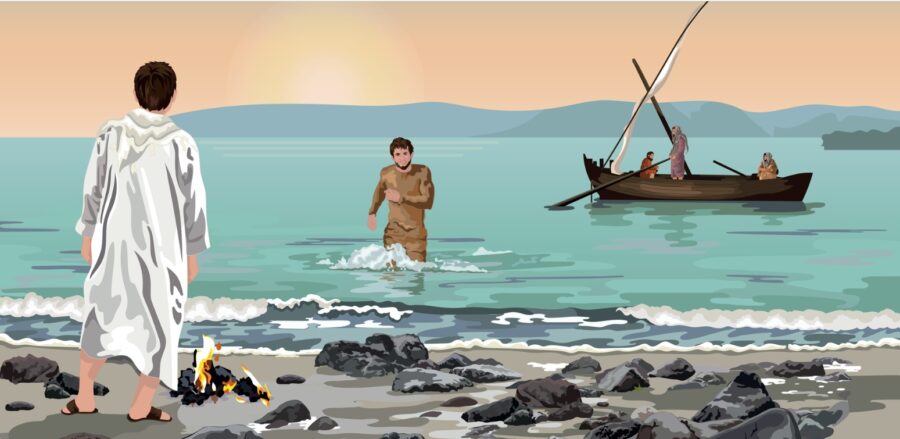
He revealed himself in this way. Together were Simon Peter, Thomas called Didymus, Nathanael from Cana in Galilee, Zebedee’s sons, and two others of his disciples. Simon Peter said to them, “I am going fishing.” They said to him, “We also will come with you.” So they went out and got into the boat, but that night they caught nothing. When it was already dawn, Jesus was standing on the shore; but the disciples did not realize that it was Jesus. Jesus said to them, “Children, have you caught anything to eat?” They answered him, “No.” So he said to them, “Cast the net over the right side of the boat and you will find something.” So they cast it, and were not able to pull it in because of the number of fish. So the disciple whom Jesus loved said to Peter, “It is the Lord.”
When Simon Peter heard that it was the Lord, he tucked in his garment, for he was lightly clad, and jumped into the sea. The other disciples came in the boat,for they were not far from shore, only about a hundred yards, dragging the net with the fish. When they climbed out on shore, they saw a charcoal fire with fish on it and bread. Jesus said to them, “Bring some of the fish you just caught.” So Simon Peter went over and dragged the net ashore full of one hundred fifty-three large fish. Even though there were so many, the net was not torn. Jesus said to them, “Come, have breakfast.” And none of the disciples dared to ask him, “Who are you?” because they realized it was the Lord. Jesus came over and took the bread and gave it to them, and in like manner the fish.
This was now the third time Jesus was revealed to his disciples after being raised from the dead. When they had finished breakfast, Jesus said to Simon Peter, “Simon, son of John, do you love me more than these?” Simon Peter answered him, “Yes, Lord, you know that I love you.” Jesus said to him, “Feed my lambs.” He then said to Simon Peter a second time, “Simon, son of John, do you love me?” Simon Peter answered him, “Yes, Lord, you know that I love you.” Jesus said to him, “Tend my sheep.” Jesus said to him the third time, “Simon, son of John, do you love me?” Peter was distressed that Jesus had said to him a third time, “Do you love me?” and he said to him, “Lord, you know everything; you know that I love you.” Jesus said to him, “Feed my sheep.
Amen, amen, I say to you, when you were younger, you used to dress yourself and go where you wanted; but when you grow old, you will stretch out your hands, and someone else will dress you and lead you where you do not want to go.” He said this signifying by what kind of death he would glorify God.
And when he had said this, he said to him, “Follow me.”
Reflection
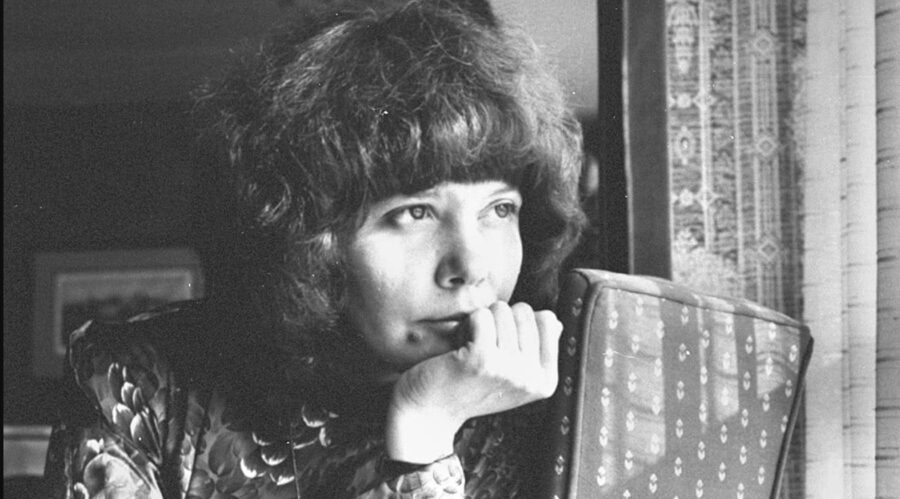
Irina Ratushinskaya was a Russian poet, writer, and activist. In September of 1982 she was arrested and accused of anti-Soviet agitation. The following March she was sentenced to seven years hard labour and five years internal exile. Her crime, according to authorities, was writing poetry of which they did not approve. In reality, her poetry and writing centred on love, Christian Theology, and artistic creation, not on politics or policies as her accusers stated. She had being leading a relatively happy life as a teacher, but her world seemed to fall apart with her arrest and imprisonment.
She suffered terribly in prison, and as a result developed heart, liver, and kidney trouble. Even so, she continued to write and smuggled out her poetry on scraps of paper given to sympathetic warders, soldiers, and visitors. She was finally released in 1986 and credited her survival to her Christian faith. She said: “When you are in trouble, and under pressure, God always seems closer. God was like a hand on my shoulder in the camp. My faith taught me to prevent my psychological life being damaged by hatred and bitterness…to be happy despite any circumstance.” She was a tremendously strong and remarkable woman. She died in 2017.
Friends, what do we do when the bottom falls out of life? What do we do when our life seems to fall apart? It maybe circumstances beyond our control – it could be something that we ourselves said or did – it could be the fault of another, but what do we do when everything goes wrong?
This is the dilemma which the Apostles face in the Gospel. As a group, they are overcome by life, circumstance and outcome. Their lives are in tatters. Everything that they had come to believe in, and trust was gone. Some of it was their own fault and cowardice. It seemed that everything that had made them secure, hopeful and happy was ruined or so they thought. Seeing that things were so bad they decided to return to the one thing that they knew well – the one thing that had given meaning to their lives before – the sea.
The Apostles believed that being on the sea would remind them of happier days – bring them a sense of comfort and familiarity, a reminder of what once was. Yet, even here, failure follows and finds them. Catching nothing, it seems that they have lost their touch, and they must have asked if things would ever be the same again?
As they ponder these questions and more, Jesus comes among them. He stands with them in their failure, regrets, and doubts. Immediately, things get better. There is an opportunity to find their touch again, hauling a great catch. Then there is the opportunity to put right recent wrongs and rediscover the love, forgiveness and strength of God – being able to say three times how much they love, rather than deny, the Lord. They realize that they are not abandoned to a cruel world or to their own failures but are forever graced with God’s presence and are secure with His hand on their shoulder.
Friends, we are reminded today of what Faith is all about. Our Gospel is telling us why we should and do believe. We realise, like the Apostles, that hope, given through Faith, is something that is never behind us but always with us. The disciples felt that they might never escape from the experience of Holy Week. They were hopelessly trapped in an internal prison of their own making, but Christ sets them free.
There will always be something of our own making or that of another which will upset us. However, today we are reminded that we are not neglected to a cruel world, or an unfortunate circumstance, or past misjudged word or action. We are children of God, and our hope is in the fact that God continually asks us “Do we love Him?”
If we love Him, God asks us to prove that love, not by remaining trapped by anything in our past but by the goodness of our present and future. God is always close; His hand is always on our shoulder, allowing us to be happy despite any circumstance.
Fr. Richard