

Gospel & Reflection for the Twenty-Sixth Sunday in Ordinary Time
Luke 16:19‐31
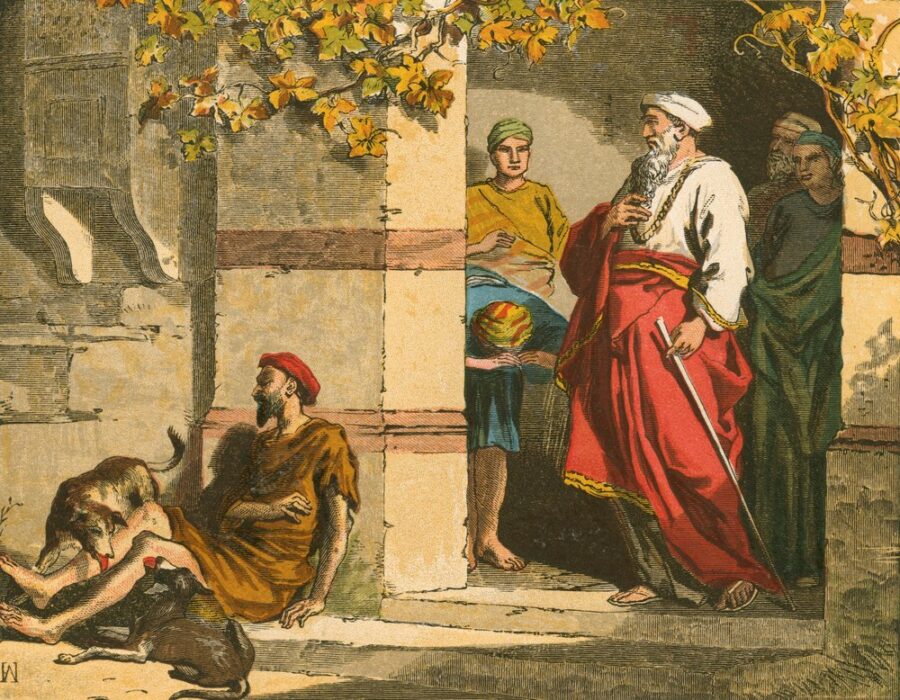
Jesus said to the Pharisees: ‘There was a rich man who used to dress in purple and fine linen and feast magnificently every day. And at his gate there lay a poor man called Lazarus, covered with sores, who longed to fill himself with the scraps that fell from the rich man’s table. Dogs even came and licked his sores. Now the poor man died and was carried away by the angels to the bosom of Abraham. The rich man also died and was buried.
‘In his torment in Hades he looked up and saw Abraham a long way off with Lazarus in his bosom. So he cried out, “Father Abraham, pity me and send Lazarus to dip the tip of his finger in water and cool my tongue, for I am in agony in these flames.” “My son,” Abraham replied “remember that during your life good things came your way, just as bad things came the way of Lazarus. Now he is being comforted here while you are in agony. But that is not all: between us and you a great gulf has been fixed, to stop anyone, if he wanted to, crossing from our side to yours, and to stop any crossing from your side to ours.”
‘The rich man replied, “Father, I beg you then to send Lazarus to my father’s house, since I have five brothers, to give them warning so that they do not come to this place of torment too.” “They have Moses and the prophets,” said Abraham “let them listen to them.” “Ah no, father Abraham,” said the rich man “but if someone comes to them from the dead, they will repent.” Then Abraham said to him, “If they will not listen either to Moses or to the prophets, they will not be convinced even if someone should rise from the dead.”

Reflection
Friends, Leona Helmsley was a New York billionaire. As a businesswoman and hotelier, she was known for her flamboyant personality and tyrannical behaviour. Her cruelty towards her employees, her disdain for ordinary, hardworking people, her belief that only the poor should pay taxes, it earned her the moniker “The Queen of Mean”. But Mrs. Helmsley was not totally mean. As hard as her heart was, there was a small amount of room in there for a special ‘someone’. That ‘someone’ was her pet dog; a miniature Maltese Poodle whom she named ‘Trouble’.
However, when Leona Helmsley died in 2007, little Trouble created very big trouble when she inherited twelve million dollars of her owner’s money! Not surprisingly, the trustees of the Helmsley estate went to court to get that amount reduced because it just was not possible to spend that amount of money on a dog, even though the security bill for Trouble’s safety was one hundred thousand dollars a year!
Whenever we hear about such people, people with so much that they seem to do ridiculous things with it, it makes us raise our eyes to heaven and no doubt we would assure ourselves that if we had such money, we would put it to better use! But while we don’t have the wealth of the likes of Leona Helmsley, Elon Musk or Jeff Bezos, just how much wealth do we have compared to the rest of the world? Where might we come on the rich list? It is sobering for us all to know that if we keep some food in a fridge, have clothes in a wardrobe; if we have a bed to sleep in and a roof over our head – then we are richer than 75% of the entire world population. We might not be Warren Buffett rich or even ‘Trouble’ rich, but we are better off than we might appreciate.
We should take note that in our Gospel for this weekend, Jesus does not condemn money or anyone who has it, either in large or small amounts. Jesus knew well, as we all know too, that a prayer is not accepted as legal tender over any counter in the world. Money has a very practical use, and we all need it. But the readings do caution us not to allow anything in the world, especially money, to smother our naturally decent and good nature.
The Prophet Amos, of the first reading, lived six hundred years before the birth of Christ. He offers a graphic description of the indulgence of the wealthy of his own day: “…lying on ivory beds… bawling to the sound of the harp…dining on lambs from the flock…drinking wine by the bowlful…but about the ruin of Joseph they do not care at all.” ‘Joseph’ was the collective name given to all the people who made up the twelve tribes of Israel. Again, Amos is critical not of what some people have, but of what they have not – no thought, no empathy, no consideration for others.
The same is true of the parable of the rich man and Lazarus. It is a story of contrast. One has everything, the other has nothing. Both men are neither evil or unlucky but one is self-centered and totally insensitive. That insensitivity is felt most by Lazarus, who while so close to the abundance of the rich man was ignored by him.
Friends, how much or how little we have never comes in to play with God. With God, it is all about the treasure of our nature and the wealth of our humanity. He wishes only that we would have a richness of heart, with a profit of kindness. That richness of heart is clear in you, and in our community. That abundance of our heart is what allows us to weep for the starving children and all who suffer in Gaza; what allowed us to open our homes to families fleeing from the Ukraine; what makes us one of the most charitable people and countries of the world, as we respond instinctively to different needs, both at home and abroad.
This weekend, the Lord reminds us of the eternal significance of such a richness of heart expressed towards others, compared to a fleeting prosperity that numbs us to the needs and consideration of others. May we never lose our generous heart; it is how we reveal God to others.
Fr. Richard