

Holy Thursday Mass of the Lord’s Supper – Gospel & Reflection
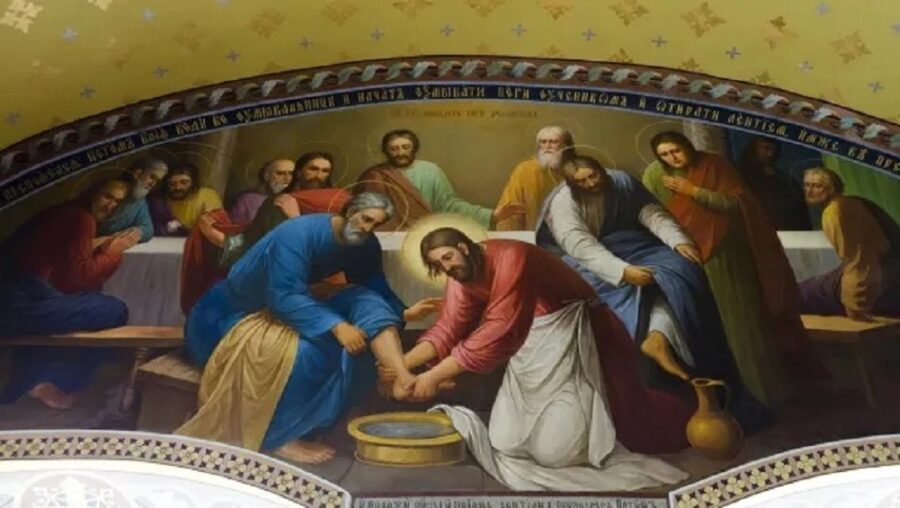
John 13:1-15
Before the Feast of the Passover, when Jesus knew that his hour had come to depart out of this world to the Father, having loved his own who were in the world, he loved them to the end. During supper, when the devil had already put it into the heart of Judas Iscariot, Simon’s son, to betray him, Jesus, knowing that the Father had given all things into his hands, and that he had come from God and was going back to God, rose from supper. He laid aside his outer garments, and taking a towel, tied it round his waist. Then he poured water into a basin and began to wash the disciples’ feet and to wipe them with the towel that was wrapped round him. He came to Simon Peter, who said to him, ‘Lord, do you wash my feet?’ Jesus answered him, ‘What I am doing you do not understand now, but afterwards you will understand.’ Peter said to him, ‘You shall never wash my feet.’ Jesus answered him, ‘If I do not wash you, you have no share with me.’ Simon Peter said to him, ‘Lord, not my feet only but also my hands and my head!’ Jesus said to him, ‘The one who has bathed does not need to wash, except for his feet, but is completely clean. And you are clean, but not every one of you.’ For he knew who was to betray him; that was why he said, ‘Not all of you are clean.’
When he had washed their feet and put on his outer garments and resumed his place, he said to them, ‘Do you understand what I have done to you? You call me Teacher and Lord, and you are right, for so I am. If I then, your Lord and Teacher, have washed your feet, you also ought to wash one another’s feet. For I have given you an example, that you also should do just as I have done to you.’
Reflection
Good evening, everyone and welcome as we gather for the beginning of our Easter Triduum – our three days of journeying with Christ through His passion, death, and Resurrection. These days are not separate occasions. They combine to make one celebration, each day leading us into the other. Our Mass tonight celebrates the Last Supper, where Christ instituted the Eucharist, but this leads us into Good Friday, and Good Friday brings us to Easter, to the Resurrection.
So, one celebration, spread out over three days and these days are the most important, most beautiful, most solemn of our Church’s year. Thank you for taking this journey and celebrating with us.
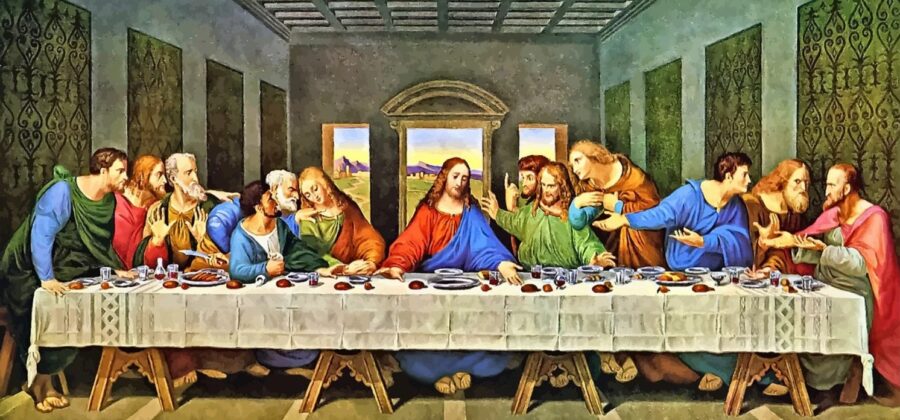
One of the most famous depictions of our celebration tonight is of course Leonardo Da Vinci’s mural of the ‘Last Supper’ which he painted on the wall of a dining hall in a Convent in Milan. It took him three years to complete, finally doing so in 1498. It has become one of history’s most influential works of art and over the centuries has survived extreme deterioration, wars, and explosions.
It is Da Vinci’s interpretation of an event chronicled in all four Gospels. He captures in it, the explosive moment of the chaos that ensues after Christ has dropped His own bombshell that one of the disciples, one of those at the table, would betray Him. They were already somewhat shellshocked having experienced Him serve them by washing their feet and having been invited to do the same for others! But this additional, unexpected wallop of betrayal, evokes various reactions from them all, from horror to anger, shock to concealment. Da Vinci captures it all.
However, have you ever noticed that in Da Vinci’s painting and in nearly all depictions of the Last Supper, including our own above the Sanctuary,, there is always space at the table! “Why’s that?” we might ask, and most certainly “why’s that?” someone asked the renowned artist himself. Da Vinci answered simply and obviously:
“So that there may be plenty of room for us to join them.”
Well, this evening, and every time we attend the Eucharist, we do just that. We pull up a chair and take our place at table with the Lord.
We come just as we are, like the original Apostles – with all our strengths and weaknesses, our perfections, and imperfections, in the order and chaos of our lives. Here, we listen as He teaches us, loves us, challenges us. Here, He tells us the truth and He invites us to change the world by following Him.
It is a huge task, but to complete it He strengthens us with the gift of Himself. He nourishes us with His Body and Blood, the Eucharist. He calls on us to become what we receive and to bring more people back to His table with us. We bring people along with us by living out with them, the love and service that Christ showed through the washing of feet. Jesus’ first gift was His own loving example of service. He instituted the Eucharist to give His followers, to give us, the food and the strength we need to follow that loving and difficult example.
Through the Eucharist, the Lord enters our hearts, and there He shapes and forms us as His disciples, showing us how to live and love.
Sharing in the Lord’s Body and Blood is meant to impart in us a newfound love, respect, and hope in our relationship with God and our neighbour. What Christ has done for us; we must do for each other.
So, tonight, and always, Jesus invites us to His table. Here, He gives us the Eucharist, His Body and Blood. It is our food, our nourishment, our strength, given to us so that we too can live lives of service and love. The only bombshell left to drop is if people turn away or refuse what is on offer at His table.
May we never be part of such chaos but only take our place at table, and be glad to do so.
Fr. Richard
