
Gospel & Reflection for the Feast of the Most Holy Body and Blood Of Christ – Corpus Christi.
Luke 9:11‐17
Jesus made the crowds welcome and talked to them about the kingdom of God; and he cured those who were in need of healing.
It was late afternoon when the Twelve came to him and said, ‘Send the people away, and they can go to the villages and farms round about to find lodging and food; for we are in a lonely place here.’ He replied, ‘Give them something to eat yourselves.’ But they said, ‘We have no more than five loaves and two fish, unless we are to go ourselves and buy food for all these people.’ For there were about five thousand men. But he said to his disciples, ‘Get them to sit down in parties of about fifty.’ They did so and made them all sit down. Then he took the five loaves and the two fish, raised his eyes to heaven, and said the blessing over them; then he broke them and handed them to his disciples to distribute among the crowd. They all ate as much as they wanted, and when the scraps remaining were collected they filled twelve baskets.
Reflection
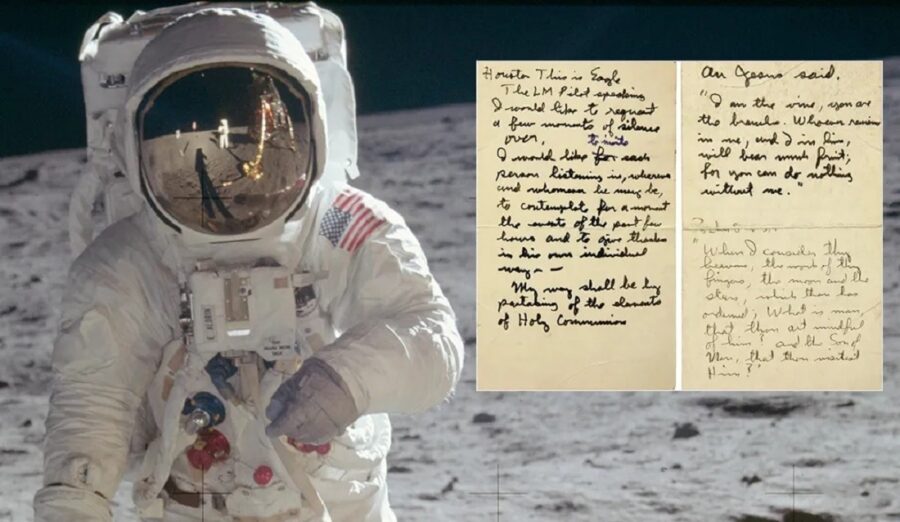
Friends, as you all know, it was on Sunday, July 20th, 1969, that Apollo 11 landed on the Moon. The most famous and recognised part of that achievement were Neil Armstrong’s first words as he stepped onto the moon’s surface and which were relayed back to Earth, “That’s one small step for man, one giant leap for mankind.” A less well known fact is that the first meal eaten on the Moon was the Eucharist, and it was consumed by Astronaut Buzz Aldrin.
The day before the launch of the Apollo 11 mission, in his Hotel room, Aldrin served Mass celebrated by his local Priest, Fr. Dennis Barry, who hailed originally from Cork. After Mass, Fr. Barry gave Aldrin the Body of Christ in a pyx to bring to the Moon. So, as Neil Armstrong set human footprints on the surface of the Moon for the first time, Aldrin read from the Gospels, “I am the vine, you are the branches. He who abides in Me, and I in him, bears much fruit.” Then, silently, he gave thanks for their successful journey to the moon and received Jesus in the Eucharist. Only then did he descended onto the Moon himself and walked with Armstrong but having first walked with God.
Ever since we were children, one of our first lessons about God was that God is everywhere and that He is always with us. The Eucharist makes this possible. Through it, Christ is present to us and in receiving Him, it strengthens us to share in His life and mission of proclaiming the Good News in what we say and do. But for the Eucharist to have that effect, to be in Christ’s presence and to become what we receive, we must believe in what we receive.
It sounds idiotic to even say that, but you would be incredibly surprised at how many Catholics do not believe in the Real Presence. This is a regrettable reality because what we believe about the Eucharist is what sets us apart from other religions, and very sadly, what even divides us from other Christian denominations. But it is a truth on which there is no compromise because it is compromise or it is Christ.
We choose Christ because there are aspects of our faith and belief which we cannot remain neutral on. Believing in Christ’s presence in the Eucharist, it is not a multiple choice question, where any answer is fine and a person’s faith is unaffected. It is not marginal or secondary to our Faith. It is central to it.
If we reject the truth of the Eucharist, if we do not believe in Christ truly present in Communion, then our intimate union with Christ is gone. Christ becomes simply some historical figure who lived two millennia ago: just some good person who led by example. We relegate him to a decent human being; we leave Him behind in that first century. The Jesus of history is no longer the Jesus of Faith. He is not the one who suffered, died and rose again and who promised to be with us always, “to the end of time.” If it is not in the Lord’s power to be present here at our table today, how can He be anywhere else and what else can He do for us?
But He is here, and He wishes to be with us and a part of us always – not as a symbol, a memory, or a token but as Body, Blood, Soul and Divinity. The Jesus of history and the Jesus of Faith makes Himself present to us always in the Eucharist and it is this that makes sense of everything else that we believe about Him.
From the earth to the moon, and beyond, God is present, God is with us. But more importantly, look no further than where you are. God is here. He is in the blessed Sacrament of Eucharist and He asks us to believe in Him and to worship Him. May we do so, fully believing in the true presence. Is it His greatest gift to us; it is our greatest treasure.
Fr. Richard