

Gospel & Reflection
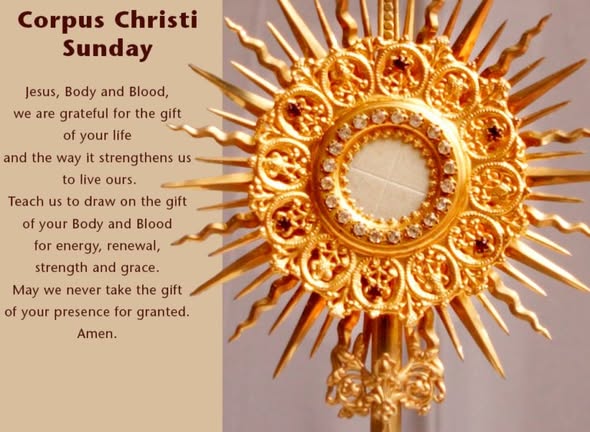
Feast of Corpus Christi – The Body and Blood of Christ.
John 6: 51-58
Jesus said to the Jews:
I am the living bread which has come down from heaven. Anyone who eats this bread will live for ever; and the bread that I shall give is my flesh, for the life of the world.’
Then the Jews started arguing with one another: ‘How can this man give us his flesh to eat?‘ they said.
Jesus replied: I tell you most solemnly, if you do not eat the flesh of the Son of Man and drink his blood, you will not have life in you.
Anyone who does eat my flesh and drink my blood has eternal life,
and I shall raise him up on the last day. For my flesh is real food and my blood is real drink. He who eats my flesh and drinks my blood lives in me and I live in him. As I, who am sent by the living Father, myself draw life from the Father, so whoever eats me will draw life from me. This is the bread come down from heaven; not like the bread our ancestors ate: they are dead, but anyone who eats this bread will live for ever.’
Reflection
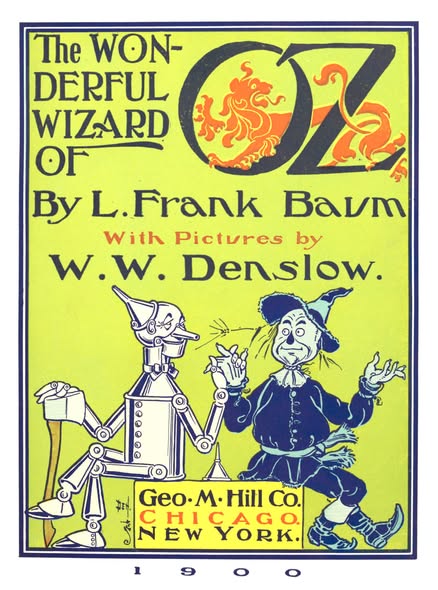
As charming as the 1939 film ‘The Wizard of Oz’ is, it does not compare to the original book, upon which it is based. Written by L. Frank Baum, ‘The Wonderful Wizard of Oz’ was first published in 1900 and tells the fantasy tale of Dorothy in the land of Oz, and the characters she meets on the way. One of those characters is the Tin woodsman who longs to have a heart, which he hopes the Wizard of Oz can give him. This tinman has a surprisingly gruesome backstory.
He was once a real, flesh, and blood man by the name of Nick Chopper! He is deeply in love with a woman called Nimmie, who has agreed to marry him. But Nimmie works as a maid for a mean old woman who does not want to lose Nimmie as her servant. This nasty woman bribes the Wicked Witch of the East to curse the axe of Nick Chopper. So, every time he wields his axe, it turns against him, severing his limbs and eventually his whole body.
After each accident though, a clever tinsmith fabricates him a functional new body part out of tin, but after the final blow, while being able to fabricate a torso, he could not provide him with a heart. Without a heart, Nick loses his love for Nimmie and no longer cares about marrying her. He keeps working until rain rusts him solid. However, he never forgets what it feels like to be human and in love. He therefore values love above all else. He famously debates with another character, the Scarecrow, on the relative importance of heart versus brains. He says: “While I was in love, I was the happiest man on earth; but no one can love who has not a heart…and love is the best thing in the world.”
Well, today we come to the heart of the matter of our faith. Today we celebrate the feast of Corpus Christi, the Body, and Blood of Christ. The Eucharist is the sign of God’s love for you and me, the sign of His love for the world. He gifts us His very self; gifts us His body and blood, His soul and divinity. Every time we come to Mass, every time we receive the Eucharist, we are then not just receiving His body and blood, we are receiving His heart and love too.
However, the real question today is not God’s love and abundant heart for us, He has already proved that. The question is do we love and have a heart for God in return, to the point where we believe the Eucharist to be His body and blood? Do we accept in the appearance of bread and wine that God is present; that the Last Supper is once again real and do we revere, respect, and give it the dignity it deserves?
You see, believing in the true presence is not a multiple-choice question, where any answer is fine and a person’s faith unaffected. Truly believing in the Eucharist as God physically present to us is not marginal or secondary to our Faith. It is central to it. If we reject the truth of the Eucharist, if we do not believe in the Real Presence, then our hope of an intimate union with God is gone. We cannot become whom we receive, if we do not believe in what we receive. We cannot become Christ-like because not believing in the true presence, is the same as not believing in God, full stop.
Jesus Christ, if He is lucky, simply becomes for us, a historical figure; a good person, who led by example two millennia ago. We relegate Him, reject Him to that first century. The Jesus of history is no longer the Christ of Faith. He cannot be the One, who having suffered and died, then rose again, promising to be with us always, “to the end of time.” If it is not in His power to be present here, at our table today, how can He be anywhere else, and what else can He really do for us? Our hope in Him as God is very much misplaced, along with all we might expect of Him.
However, I am sure that we do believe He is here – not as a symbol, a memory, or a token but as Body, Blood, Soul and Divinity. The Jesus of history and the Christ of Faith makes Himself present to us always in the Eucharist and it is this that makes sense of everything else that we believe about Him. God is with us. God is here. He is in the Blessed Sacrament of the Eucharist and He asks us to believe, receive, and worship Him.
To do so is to love Him with all of our heart, and to love Him is the best thing in the world.
Fr. Richard