


Gospel & Reflection for the Fifth Sunday of Easter.
John 13:31‐33,34‐35
When Judas had gone Jesus said:
‘Now has the Son of Man been glorified,
and in him God has been glorified.
If God has been glorified in him,
God will in turn glorify him in himself,
and will glorify him very soon.
‘My little children,
I shall not be with you much longer.
I give you a new commandment:
love one another;
just as I have loved you,
you also must love one another.
By this love you have for one another,
everyone will know that you are my disciples.’
Reflection
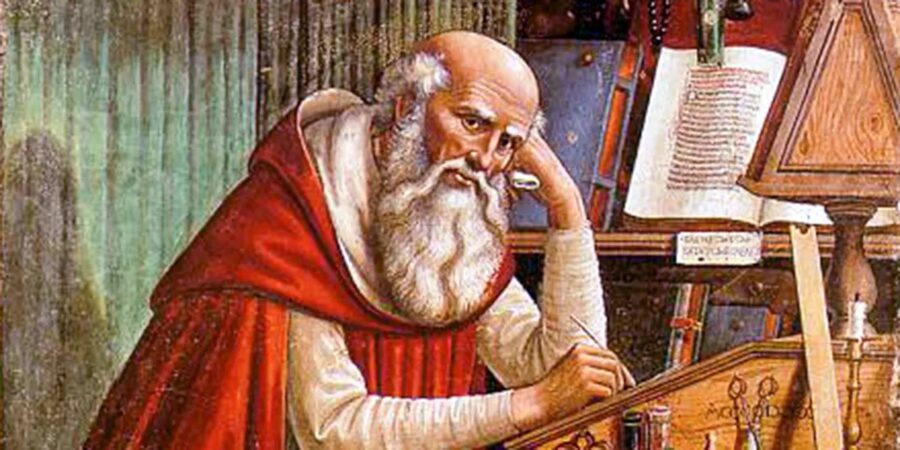
Friends, born in the middle of the fourth century in Croatia, Eusebius Sophronius Hieronymus would become one of the Catholic Church’s most significant converts, and in his lifetime would make a momentous contribution to the Christian Faith. We know him today as Saint Jerome and he was the first great Scripture Scholar. He is the person responsible for translating the entire Bible into Latin; a labour of love that made the scriptures accessible to more people across the then known world, than was ever thought possible. As well as translating the Bible, he also wrote commentaries about it, explaining its deep meaning and importance.
Apart from the Bible, he penned many history books too, recording the early story of the Church, and these books are a crucial source of information not just about the history of the Church but also of its people. Jerome documented dramatic events and beautiful insights into different people. For example, he records a story about St. John the Evangelist, whose Gospel we read from today. He archived that when St. John was an old man and could no longer compose a sermon because of his bad eyesight, he instead would repeat constantly aloud: “Little children, love one another.” When people asked John why he always repeated those same words, he replied: “Because if you do that, you do enough!”
Love should always be enough for everyone and everything. Wherever there is love, there is God and where there is God there is life and goodness. Love, in fact, was the one ingredient which saw Christianity overtake the many pagan religions of the ancient world. It’s believed now by scholars that ten years after the death and Resurrection of Christ, within the vastness of the Roman Empire, the number of Christians totalled about one thousand. However, after three hundred years, in the time of Jerome, that number had grown to over thirty-four million people or nearly 60% of the population of the Roman Empire.
One of the reasons for this rapid growth of Christianity was down to the fact that for the most part, pagan gods seemed to pay little attention to things ‘down below.’ A simple phrase such as ‘God loving the world,’ so basic and true to a Christian, would have been puzzling to a pagan.
The idea of a God loving those who love Him, was not only new to pagans but beyond their grasp. No self-respecting pagan thought they were loved by their gods! So, the one emotional ingredient missing from ancient paganism was love. Pagans believed that their gods might come to their aid, but they did not believe that their gods loved them. The result was that many pagans mostly feared their gods, admiring some of them but envying all of them. But along then came Christianity and one of its central truths and facts is: “For God so loved the world, that He gave His only Son.”
This reality of a God who loves and cares and as expressed in the good example and love of the early Christians, this reality appealed to people on such an unprecedented scale, that in just over three centuries, 60% of a worldwide empire, left behind their aloof and cruel gods and bowed down to a crucified Saviour. This, within a culture where a religion founded after a crucified criminal, would normally have been considered ridiculous and abhorrent.
However, love is never ridiculous, never distasteful, and never should be rejected. A God who loves unconditionally and who proved His love by sending His only Son, was the one thing that the might and force of the Roman Empire never considered, and this one loving God was what saw the Roman Empire begin its decline as a political and military force.
Our Gospel today expresses this truth of love. It reminds us, challenges us, that the force of this love, a love that overcame death and overpowered an empire, is a force still at work in the world and in our lives. It is a force for the good; it is a force for the better. Some might disagree and argue the opposite but whatever about their opinions, they have yet to present and promote a better alternative.
We are asked always never to underestimate the power of love in our lives as established by our faith in God. We are asked never to deny it, never to mistrust it, but instead to give it all the room we can to breath, move and speak. In all that we say and do, we are asked to love as Christ loved; to love as God wants us to. It is a mighty challenge! Yet, in the words of St. John as recorded by Jerome: ‘If we do that, we do enough.’
Fr Richard