

Gospel & Reflection for Easter Sunday.
John 20:1‐9
It was very early on the first day of the week and still dark, when Mary of Magdala came to the tomb. She saw that the stone had been moved away from the tomb and came running to Simon Peter and the other disciple, the one Jesus loved. ‘They have taken the Lord out of the tomb’ she said ‘and we don’t know where they have put him.’
So Peter set out with the other disciple to go to the tomb. They ran together, but the other disciple, running faster than Peter, reached the tomb first; he bent down and saw the linen cloths lying on the ground, but did not go in. Simon Peter who was following now came up, went right into the tomb, saw the linen cloths on the ground, and also the cloth that had been over his head; this was not with the linen cloths but rolled up in a place by itself. Then the other disciple who had reached the tomb first also went in; he saw and he believed. Till this moment they had failed to understand the teaching of scripture, that he must rise from the dead.
Reflection
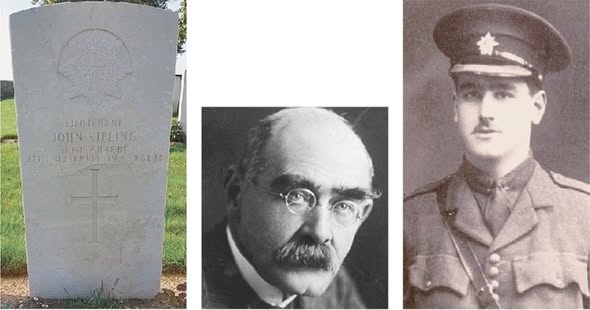
Friends, in 1926, eight years after the end of the Great War, grief stricken by the death of his only son John in that conflict and having no grave to visit because John’s body and those of his unit were not identified or recovered at that time, Rudyard Kipling penned a short story titled ‘The Gardener’. It is a story that mirrored Kipling’s personal experience of loss, grief, hidden identity, but ultimately, hope.
‘The Gardener’ tells the story of a woman named Helen Tyrell who to avoid social scandal, secretly raises her illegitimate son Michael as her nephew. Michael is aware that he is a living secret but ‘keeps his secret most loyally.’ As a young man, he enlists in the Army but is killed in 1915. Having spent her life hiding the truth about her ‘nephew,’ Helen travels to Belgium to find his grave and grieve her son. However, the military graveyard where he rests is massive, and she finds herself lost in a merciless sea of twenty thousand identical crosses, and she does not know where to begin to look. It is then that she sees a man ‘firming a young plant in the soft earth.’
Supposing him to be the gardener, she approaches. As she does, the man rises and without being prompted, asks, “Who are you looking for”. “Lt. Michael Tyrell, my nephew,” she replies, as she had said many thousands of times in her life. The gardener, Kipling then describes, looks at her with ‘infinite compassion’ and turning towards a group of black crosses, says, “Come with me, and I will show you where your son lies.”
Kipling’s short story has many echoes of the Easter story, and it captures wonderfully how the Catholic message of Easter is firmly planted in all people.
On that first Easter morning, many people are grief stricken and searching. Mary Magdalene and the other woman stand in the garden of Gethsemane and though there is only one grave to go to, there might as well have been twenty thousand because they are emotionally and spiritually lost, they do not know what to think, say or do. The Apostles are equally lost, in fear and regret they hide secretly away; their cowardice still weighing heavy on their minds. Yet, into all of this bereavement, bewilderment, and secrecy, Jesus appears and stands among them.
There is no judgement and no recrimination about past failures, there’s just presence, reassurance, and hope. All of what has been slowly fades away, leaving only renewed courage, faith, and love. What the followers of Christ gradually recognised and came to know that morning in the garden, is what brings us together on this Easter night (day): if the Cross had been the end, we would never have heard of Jesus.
But the tomb is empty and so our hearts, lives, and faith are full with the knowledge and love of Christ. The Resurrection becomes the central event that links us to the followers of Christ back then, and all of us now. Like them we encounter Christ who is alive and we too preach the Resurrection, live the Resurrection, hope for the Resurrection. God has raised His Son to new life and new life is what God offers to us always.
Jesus Christ is the true Gardener. He stands in the midst of all our lives and the world, and He tends to us softly. He sees past our secrets, our fears, our regrets; He knows our worries, our pains, our griefs. He sees us, not as we sometimes feel we must present ourselves to the world but as we really are; and He loves us.
He observes the world with its wars, violence, and suffering. He sees the world as it is, but longs for it to be as He created, and still He loves what He created.
With infinite compassion, He reassures us that He has conquered everything and all will be well.
On this night (day) above any other, let us then never lose hope, let us never lose faith. God has rolled back the stone. We see, we believe and we now live in the light of our greatest hope – Christ the Lord, raised from the dead.
Have a blessed and peaceful Easter.
Fr. Richard